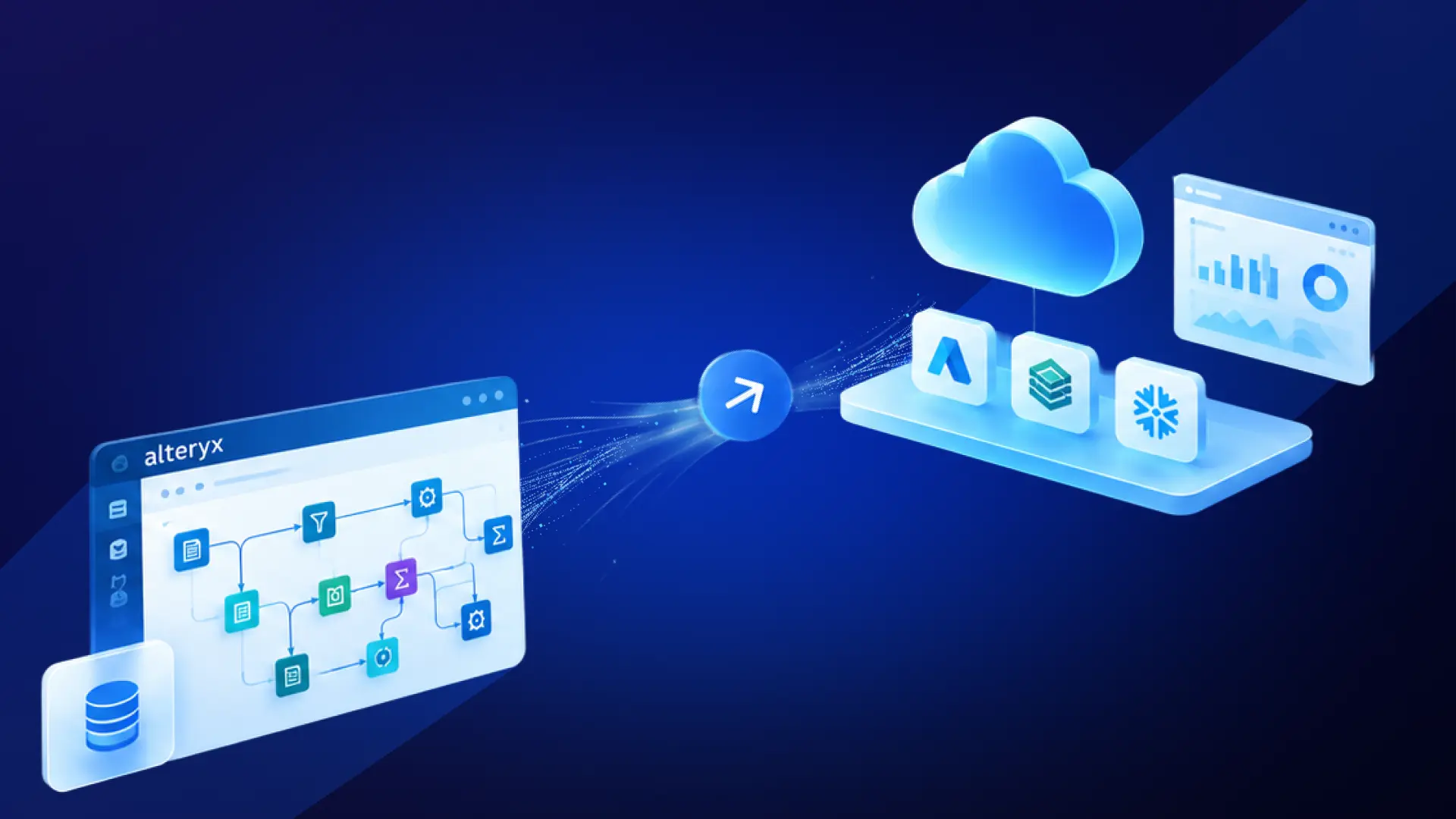
Organizations are looking to modernize their analytics ecosystem and reduce operational costs. Businesses often look for efficient migration of existing Alteryx workflows by preserving logic and data quality.
In order to ensure a smooth transfer with the least amount of disturbance to business operations, Alteryx Workflow Migration Services are offered. These services assist companies in evaluating, converting, validating, and optimizing their current processes for contemporary data platforms.
What Are Alteryx Workflow Migration Services?
Workflow assets, transformation logic, macros, and automation procedures can be moved from Alteryx to another analytics or data platform with the use of Alteryx Workflow Migration Services. Throughout the migration process, these services concentrate on maintaining workflow functionality, data integrity, and business consequences. The significance of workflow migration in enterprise analytics operations is shown by Alteryx’s own workflow migration capabilities and solutions.
Workflow migration services specifically deal with the conversion and modernization of workflow logic, dependencies, and execution processes, in contrast to more general migration initiatives that cover entire analytics environments.
Why Organizations Are Migrating Alteryx Workflows
1. Cloud Modernization Initiatives
Cloud-native systems are being used by many businesses to standardize their data and analytics operations. Contemporary systems include stronger collaborative capabilities, integrated governance, and increased scalability, all of which are more compatible with digital transformation initiatives. Translating Alteryx workflow logic into cloud-native technologies like Dataflows, notebooks, pipelines, and Lakehouse architectures is becoming more and more popular.
2. Cost Optimization
Infrastructure and licensing costs can play an important role in migration decisions. As businesses expand their analytics operations, they look for solutions that can optimize total cost of ownership while offering comparable or improved capability.
3. Improved Scalability
Growing data volumes may provide challenges for traditional workflow setups. Larger datasets can be processed, and growing business demands can be supported by modern systems, which are better equipped to manage enterprise-scale workloads.
4. Enhanced Data Governance
Organizations have to comply with ever-tougher governance and compliance standards. In order to enhance risk management and regulatory compliance, modern data platforms frequently offer centralized governance, auditing, security controls, and data lineage capabilities.
5. Better Integration Across the Data Ecosystem
Data engineering, analytics, machine learning, and reporting solutions must all be seamlessly integrated for businesses. Organizations can integrate these capabilities into a contemporary data platform through workflow migration.
Common Alteryx Workflow Migration Challenges
While migration offers significant benefits, organizations often encounter several challenges during the transition process.
Complex Workflow Dependencies
Many Alteryx workflows rely on interconnected processes, shared assets, macros, and external systems. Understanding and documenting these dependencies is critical for successful migration. Alteryx’s migration documentation emphasizes auditing workflows and their associated components before migration activities begin.
Macro and Custom Tool Conversion
Custom macros and specialized workflow components frequently require manual review and redesign because equivalent functionality may not exist in the target platform.
Data Source Connectivity
Legacy workflows often connect to a variety of databases, APIs, file systems, and external applications. Ensuring compatibility and maintaining connectivity can add complexity to migration projects.
Validation and Testing Requirements
Businesses need to make sure that migrated workflows generate results that meet current business requirements. To reduce risk and preserve stakeholder trust, thorough testing and validation frameworks are crucial. Throughout the transfer process, workflow auditing and output comparison are key components of migration best practices.
Scheduling and Orchestration
Workflow execution schedules, event triggers, and automation processes must be recreated and optimized within the new environment.
Key Components of Alteryx Workflow Migration Services
Workflow Discovery and Assessment
The migration journey begins with a detailed inventory of existing workflows, including:
- Workflow complexity analysis
- Dependency mapping
- Macro identification
- Data source discovery
- Performance evaluation
- Business criticality assessment
This phase helps organizations understand the migration scope and prioritize workloads.
Migration Planning
A structured migration roadmap is developed based on:
- Workflow complexity
- Business priorities
- Technical requirements
- Risk assessment
- Target platform capabilities
The objective is to minimize business disruption while maximizing migration efficiency.
Workflow Conversion
During this phase, workflow logic is translated into the target environment. Depending on the platform, conversions may include:
- Alteryx to Microsoft Fabric Dataflows
- Alteryx to Azure Data Factory
- Alteryx to Databricks
- Alteryx to Snowflake
- Alteryx to SQL-based transformations
- Alteryx to PySpark notebooks
Industry migration approaches often leverage automation for identifying workflow logic while reserving manual review for complex scenarios and exceptions.
Testing and Validation
Validation ensures business continuity through:
- Output comparison
- Functional testing
- Data quality assessment
- Performance benchmarking
- User acceptance testing
Successful migrations focus heavily on verifying that migrated workflows produce consistent and accurate business outcomes.
Performance Optimization
Once workflows are migrated, optimization activities improve:
- Execution speed
- Resource utilization
- Data processing efficiency
- Scalability
- Maintainability
Benefits of Professional Alteryx Workflow Migration Services
Faster Migration Timelines
Experienced migration specialists use proven frameworks, accelerators, and methodologies to reduce project duration and improve predictability.
Reduced Business Risk
Comprehensive assessment and testing approaches minimize the risk of workflow failures, data inconsistencies, and operational disruption.
Improved Platform Performance
Modern architectures often deliver enhanced performance and scalability compared to legacy workflow implementations.
Better Governance and Security
Organizations gain access to advanced governance, monitoring, auditing, and security capabilities available within modern data platforms.
Future-Ready Analytics Architecture
Migration enables organizations to establish a foundation for advanced analytics, artificial intelligence, machine learning, and real-time data processing.
Sparity’s Approach to Alteryx Workflow Migration
At Sparity, we approach Alteryx workflow migration as a structured modernization initiative designed to maximize value while minimizing risk.
Our methodology includes:
1. Assessment and Discovery
- Workflow inventory and analysis
- Dependency mapping
- Risk identification
- Migration readiness evaluation
2. Migration Strategy Development
- Target architecture design
- Platform selection guidance
- Roadmap creation
- Resource planning
3. Workflow Conversion and Modernization
- Automated and manual conversion approaches
- Business logic preservation
- Migration documentation
- Architecture optimization
4. Validation and Quality Assurance
- Data reconciliation
- Functional testing
- Performance verification
- User acceptance support
5. Post-Migration Support
- Workflow optimization
- Knowledge transfer
- User training
- Ongoing support and enhancements
Conclusion
For businesses looking to update analytics processes, enhance scalability, and align with cloud-first data plans, Alteryx Workflow Migration Services offer a structured route. Businesses can successfully move their analytics processes while preserving data quality and operational continuity by combining workflow evaluation, conversion, validation, and optimization.
Working with a seasoned migration services provider can greatly lower risk, speed up timeframes, and help you realize the full potential of your contemporary data platform—whether you’re moving a small number of workflows or a huge enterprise portfolio.
Are you prepared to update your Alteryx processes? Get a thorough workflow assessment from Sparity to learn how our migration specialists can speed up your analytics transformation process.
FAQs