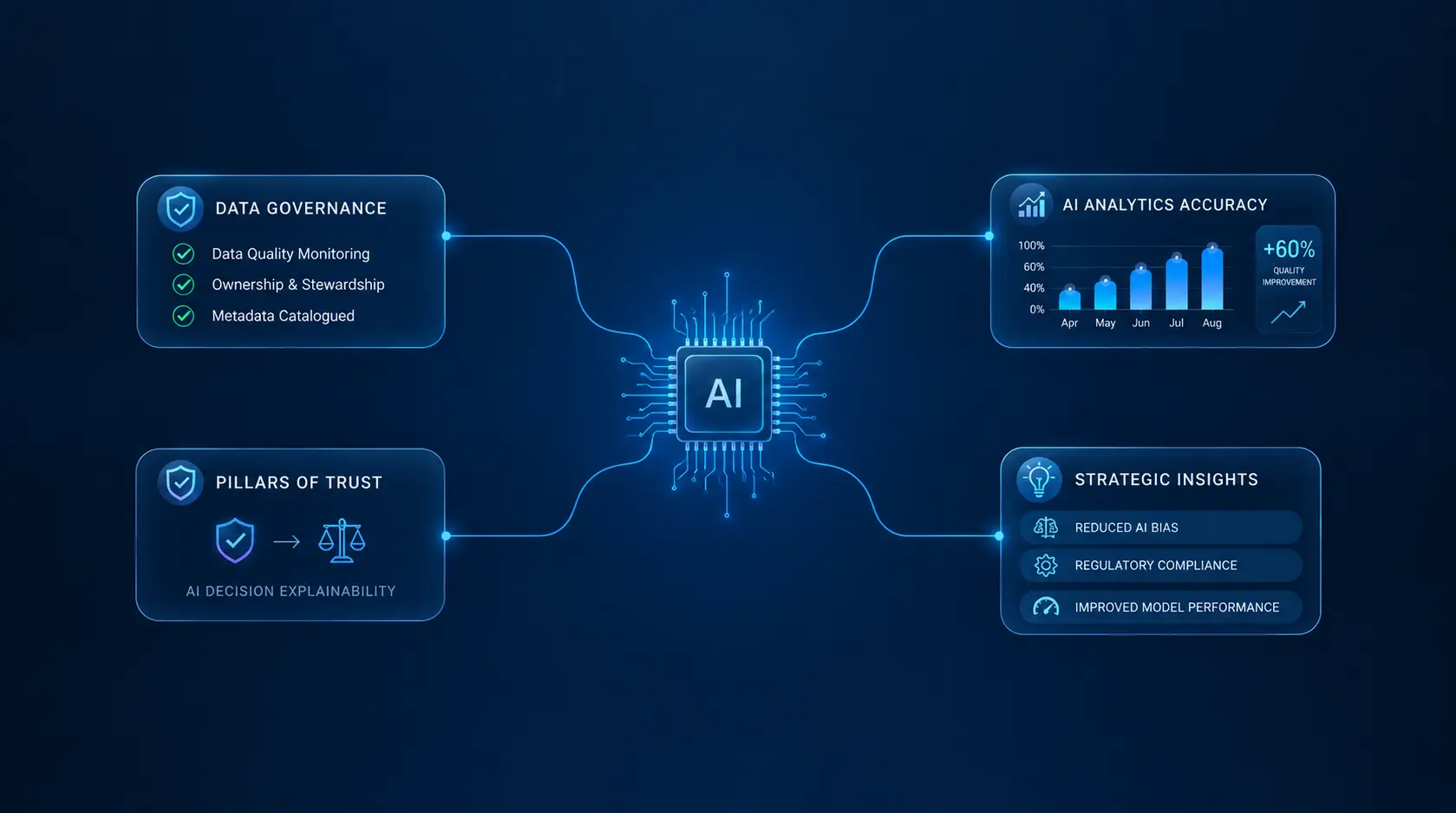
AI is by far the most impactful technology of our generation. Businesses are using AI to automate processes, optimize their business, and create better experiences for their customers. For AI to perform these tasks, it requires data. The output of AI is only as good as the data that is provided to it. As more businesses adopt AI, data governance is becoming critical for an organization to achieve accuracy, trust, compliance, and ultimately succeed.
In the age of AI, data governance has extended beyond the IT function of the business. It has now become imperative for different types of businesses.
What Is Data Governance?
Data governance is the management of an organization’s data. This includes defining how data is collected, stored, used, and secured. While data governance has always been important, it has become critical with AI.
The primary objectives of data governance are to:
- Improve the quality and accuracy of data
- Protect data
- Achieve compliance
- Define responsibility and accountability for data
- Allow for informed and trusted decisions
The AI Revolution Is Fueled by Data
Ultimately, the output of AI is only as good as the data that it is provided. If the data is bad, the output will be bad. This is true for all AI without any exception.
Consider the following examples:
- A Customer service chatbot with outdated information answers the customer’s question incorrectly.
- A sales forecasting model, which is trained in insufficient data, is ultimately not helpful.
- An AI for recruitment and staffing which replicates the biases of the historical hiring decisions of the business.
Each scenario shows that the challenge isn’t with the AI itself. Usually, the quality and consistency of the data, and how it’s governed, are the largest contributors to issues with AI.
Why Data Governance Matters More Than Ever
Building a data governance framework matters more than ever in this AI age for reasons ranging from mitigating risks to improving AI performance.
1. Building Trust in AI Outcomes
Business leaders are using AI-generated insights to make important business decisions. However, AI can only be trusted when the data it relies on is trusted.
There are many aspects of data governance that impact confidence in AI and data. These include:
- Documentation of data sources
- Validating data sources
- Traceability of data lineage
- Explanation of AI outputs
- Auditing AI outputs
When AI is powered by trusted data, stakeholders start to trust AI.
2. Mitigating Bias and Ethical Risks
AI, like other technologies, reflects the biases of the developers and historical data on which it is trained. AI is only as ethical as the humans who program it.
Data governance, and effective governance safeguards and mechanisms address ethical risks and irreparably damage the organization’s reputation.
3. Strengthening Security and Privacy
AI processes a large amount of sensitive data and increases the attack surface area for security breaches and violations of customer privacy. Data governance decreases risk exposure.
4. Ensuring Regulatory Compliance
Stricter data, privacy, and trust regulations require strong data governance to ensure compliance.
Organizations must be able to answer questions such as:
From where do the data originate?
- Who controls the data?
- How does the data get used by the AI system?
- Can the decisions made by the AI system be explained?
- Can the decisions made by the AI system be audited?
An effective governance framework addresses compliance requirements by ensuring transparency.
5. Improving AI Performance
Many organizations heavily prioritize AI model development while paying little to no attention to data quality.
Governed data results in:
- More consistency
- Greater accuracy
- Less duplication
- Better model performance
Data that is standardized and of a consistent quality results in the generation of more accurate and more useful outcomes by AI systems.
Key Pillars of AI Focused Data Governance
Modern data governance should focus on these key pillars to support AI initiatives:
Data Quality: Establish processes to continuously monitor, validate, and improve data accuracy, completeness, and consistency.
Data Stewardship: Assign ownership and accountability for critical data assets across the organization.
Metadata Management: Maintain clear documentation about data sources, definitions, transformations, and usage.
Security and Privacy: Protect sensitive information through access controls, encryption, and monitoring.
Compliance and Ethics: Implement policies that align with regulatory requirements and responsible AI principles.
The Future of Data Governance
As organizations continue to embrace AI at an accelerated pace, data governance will shift from a back-office function to a strategic priority for the business. The companies that invest in governance now will be best positioned to gain a competitive edge, innovate, and scale their business.
The future will belong not to the companies with the best AI, but to the organizations with the most trusted, governed data.
Conclusion
AI can transform the way businesses operate. However, for AI to be successfully implemented, data needs to be governed appropriately.
Without data governance, organizations can make bad decisions, expose data they should not, lose their customers’ trust, and ultimately fail in their business.
Data governance and the responsible use of AI are tightly integrated. For a responsible use of AI, strong data governance is a must. Data and AI are strategically integrated and interdependent. For an organization to reap the benefits of AI, they have to treat data as a strategic asset and govern it accordingly. Get in touch with Sparity to build a data governance framework for your organization or modernize legacy systems.
FAQs
What is data governance?
Data governance is management of an organization’s data including defining how data is collected, stored, used, and secured.
What is the main factor contributing to AI performance?
Data that is fed to AI is the most important factor in determining AI outcomes.
How does the future of data governance look?
Data governance is going to be a priority in the future. The future will belong to companies prioritizing data governance along with AI.
FAQs