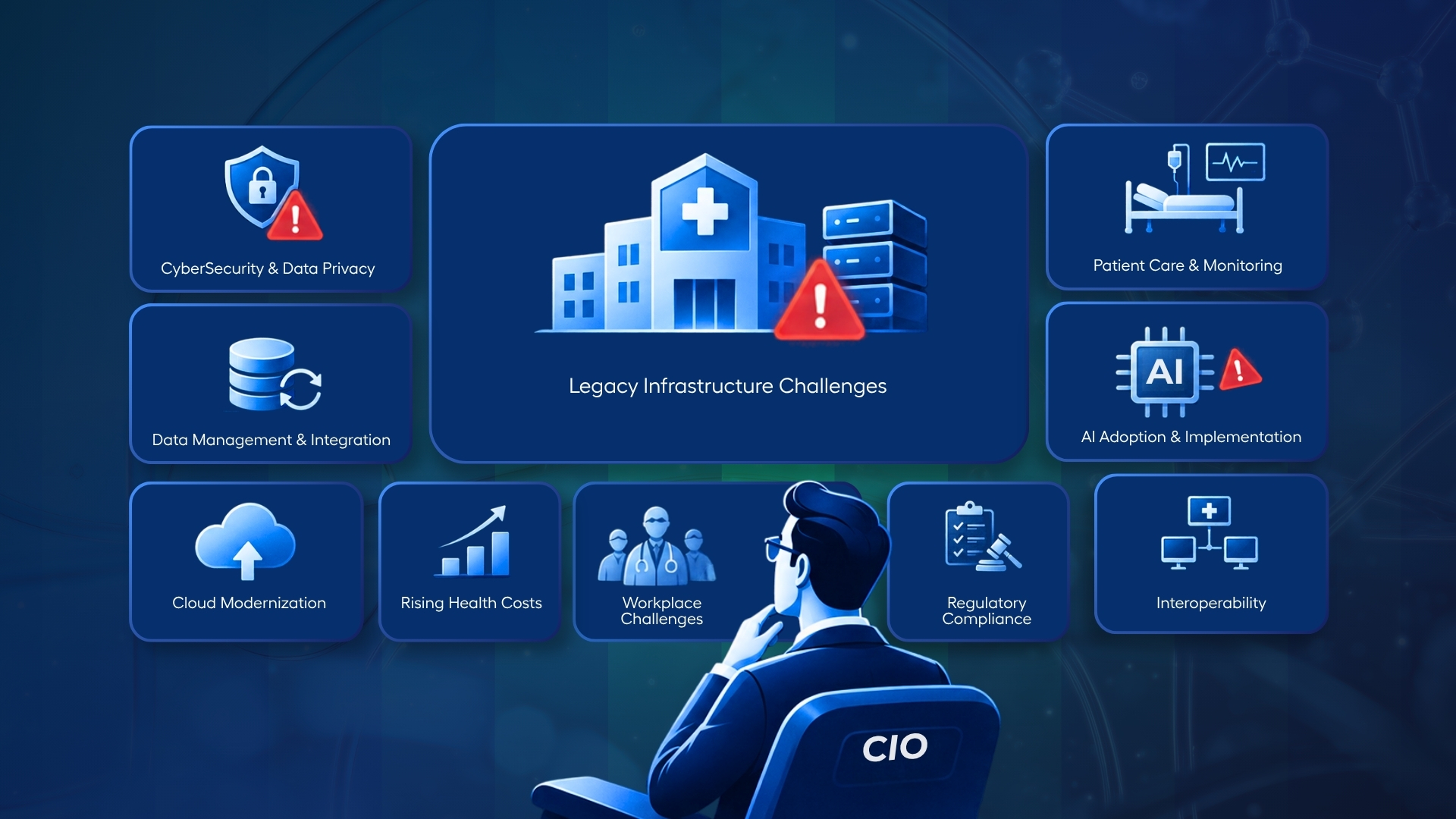
The healthcare industry is going through a period of unprecedented change. New technologies are transforming the delivery of healthcare, changing the way in which diagnostics are performed and raising the expectations of patients. While new technology has the potential to improve the efficiency and quality of healthcare services, it also adds to the burden and challenges facing healthcare leaders.
Healthcare CIOs are at the forefront of these changes. IT leaders in healthcare are no longer focused on merely implementing and managing the IT infrastructure of an organization. Healthcare CIOs need to rethink how they lead their organizations to improve and transform patient care while ensuring operational and financial success of their businesses.
Why The CIO’s Role Is Important
Healthcare organizations are constantly grappling with the increasing demands for the integration of new technologies within the sector in order to optimize clinical workflows, secure sensitive patient data, and remain compliant with regulatory standards. At the same time, healthcare leaders also need to emphasize efforts that improve patient experience and outcome.
While the objectives may seem to be within reach, the journey to accomplishing them is daunting and challenging, especially in the current economic environment. In the current technologically dominant sphere, Healthcare CIOs need to balance and resolve a myriad of conflicting challenges using their leadership skills and innovative strategies.
Key Challenges Healthcare CIOs Will Face in 2027
1. Budget Constraints vs. Innovation Demands
For Healthcare organizations, there is a constant push to modernize their technology environments while operating within reduced budgets. To keep pace with the competition, investments in areas such as Artificial Intelligence, Cloud Computing, Digital Health, Data and Analytics and Cyber Security are imperative, however these are competing for the available budget against other operational expenses and the maintenance of legacy systems.
To gain approval for technology investments, CIOs must highlight outcomes that improve the care of patients, while impacting the bottom line of the organization positively through, for example, improved staff productivity and compliance. Success is measured by the ability to achieve maximum outcome for each dollar spent.
Top of mind for CIOs are:
- How large-scale, transformational changes will be funded?
- How long will it be before the legacy systems become a net liability?
- How do we effectively encourage innovation while maintaining business operations?
2. The Rapid Rising Expectations of AI
The strategic use of Artificial Intelligence in Healthcare is no longer optional. Healthcare Executive management expects AI to change and enhance clinical decision making and overall workflows. The Engagement of Patients through the use of AI is an expected avenue for the future.
While the possibilities of AI in the Healthcare environment are numerous, so are the challenges. The Healthcare environment is complex, fragmented, and not truly inter-operable. CIOs must take a considered and measured position on AI.
The challenges and opportunities of AI in Healthcare include:
- Intellectual Property rights and governance
- How should we best incorporate AI into our organization?
- Ethics and governance
- Handling expectations of AI transformation
- Establishing, demonstrating and measuring clinical and business impact
3. Data Silos Across Systems
Varied and multiple applications, databases, and platforms are a common feature in most healthcare environments. These are the results of numerous mergers, acquisitions, and organic growth. Clinical applications such as EHRs and billing systems often function in isolated environments.
The fragmented and disconnected nature of various applications results in data silos. This negatively impacts clinicians’ ability to access necessary patient data. Healthcare leaders are equally challenged when attempting to synthesize data in a way that enables them to derive actionable insights to improve organizational performance.
Data silos can negatively impact an organization as follows:
- Delayed clinical decision-making
- Inconsistent patient data
- Increased administrative burden
- Limited interdepartmental collaboration
- Inability to track the performance of the overall organization
CIOs should focus on data integration and unified analytics to facilitate free flow of data across the continuum of care.
4. Increased Cybersecurity Threats
Given the high value nature of patient data, cyber attacks can be expected. Phishing attacks and ransomware attacks targeting patient data is on the rise.
As healthcare systems and applications become more integrated, for instance with the use of cloud computing and other advanced technologies, the attack surface area also increases. Protecting patient data while ensuring continual access to healthcare systems is a challenge for many CIOs.
Some of the top cybersecurity focus areas are as follows:
- Reinforcing security of systems and applications
- Preventing phishing and ransomware attacks
- Managing third-party risk
- Security of cloud and hybrid environments
- Enhancing threat and risk management
Further complicating matters is the increasing regulatory oversight aimed at protecting patient data and the desire of patients to ensure their data is secure.
5. Managing Regulatory Compliance
Rapid advancements in healthcare technology require continuous adjustment to regulatory compliance. The obligation of the CIO is to ensure that systems, processes, and data management services enable the required level of privacy and security to ensure compliance while supporting innovation.
As an organization moves toward a digital future, compliance becomes more and more complex. This is evidenced by the introduction of new compliance considerations created by the adoption of Cloud, Artificial Intelligence (AI), data-sharing, remote care, and other similar initiatives.
The highest priorities in compliance include:
- Preserving the privacy of personally identifiable information (PII)
- Maintaining secure access to data
- Ensuring the organization is prepared to respond to an audit
- Management of data governance
- Navigating changes in regulations
Not keeping pace with changes can adversely affect the financial health of the organization and increase operational risk.
Challenges Offer Opportunities for Change
Those challenges can be opportunities to modernize the way that healthcare services are delivered. Indeed, innovative Chief Information Officers (CIOs) embrace opportunities to build scalable digital platforms and access cloud computing and automation solutions to strengthen the resiliency of healthcare ecosystems.
To succeed in the ever-changing healthcare arena, leaders must take the following into account:
- Establishing data-driven cultures
- Implementing safe and trustworthy artificial intelligence (AI)
- Fortifying the defense against cyber-attacks
- Improving interoperability and access to data
- Creating technology teams that are flexible and adaptable to changes
Continuous focus on these imperatives will enable organizations to continuously enhance the patient experience, build long-term employee loyalty, improve business performance, and remain relevant in a turbulent environment. These challenges can be addressed by CIOs by pitching Microsoft Fabric as a solution.
Conclusion
As the strategic leaders of digital transformation, CIOs will be at the forefront of advancing the healthcare sector in coming times.
To succeed, CIOs must find ways to employ AI, address data fragmentation, and secure and protect the healthcare cyber-ecosystem, while adhering to the reimbursement and regulatory requirements, and addressing the ever present healthcare workforce challenges.
Approaching tech leaders to help them innovate their healthcare brand can be a smart decision. Reach out to Sparity to help you modernize your healthcare organization.
FAQs
What are the biggest cybersecurity challenges healthcare CIOs face?
What are the biggest cybersecurity challenges healthcare CIOs face?
Healthcare CIOs face threats such as ransomware attacks, data breaches, phishing scams, and securing sensitive patient data across cloud and connected systems.
What are the challenges of AI in healthcare?
The main AI challenges include poor data quality, data silos, integration with existing systems, regulatory compliance, bias concerns, and proving ROI from AI investments.
FAQs