Organizations need to process data quickly to derive insights and take prompt action. However, multiple data silos and data infrastructure make it difficult for organizations to derive meaningful insights.
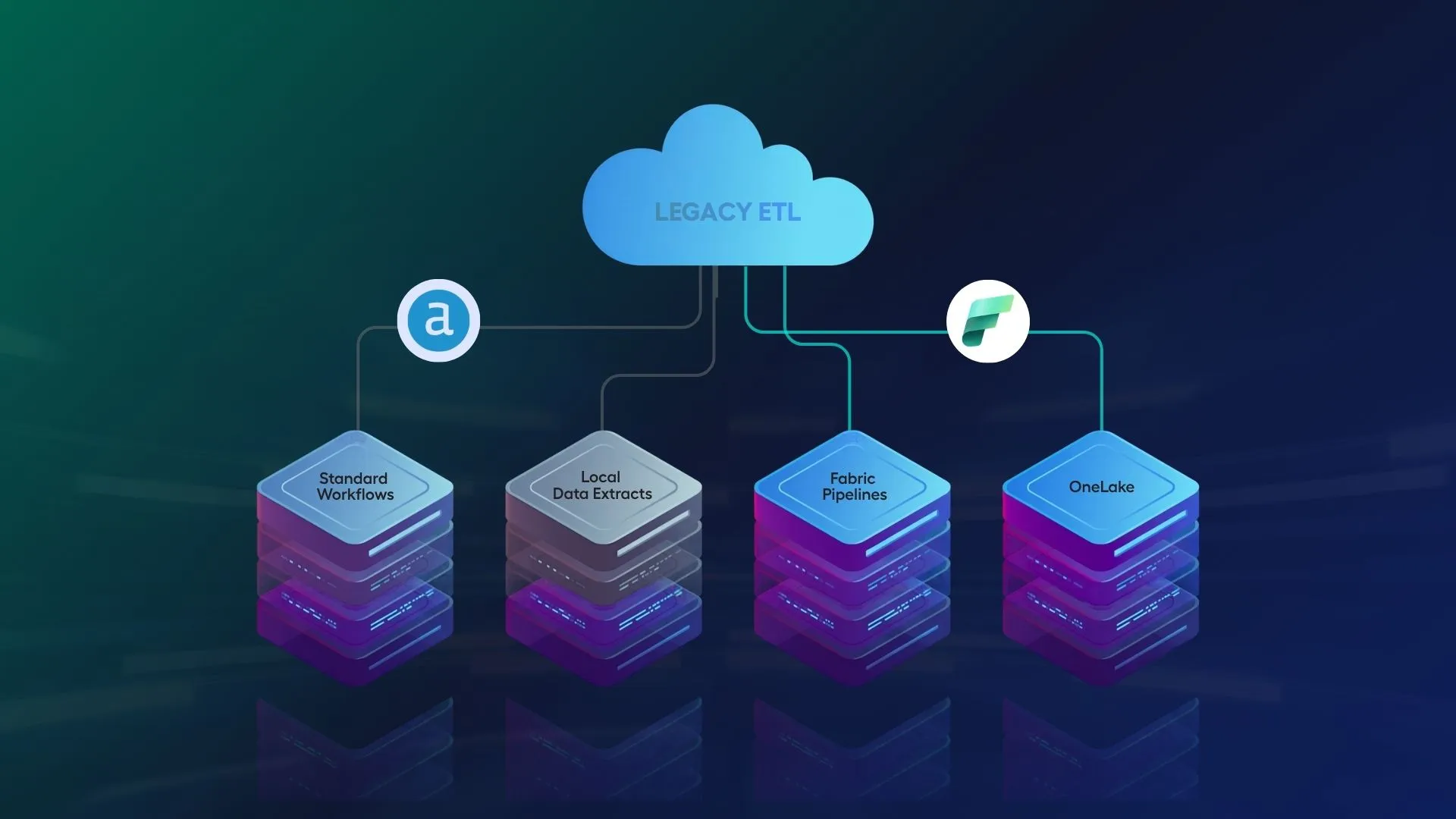
Flexibility, scalability, and cost have been some of the key tenets for organizations to adopt best-in-class solutions. These solutions, over time, integrate into an organization’s data ecosystem resulting in an unnecessary complex, cost-efficient, and time-consuming data infrastructure.
Enterprises are evaluating and adopting Microsoft Fabric. Microsoft Fabric simplifies analytics by integrating data integration, data engineering, data warehousing and data science with real-time analytics and business intelligence.
In this blog, we will examine the key reasons that fuel the migration of enterprises to Microsoft Fabric and establish it as a primary solution for modern analytics.
The Challenge of Fragmented Analytics Environments
Over a period, organizations have developed their analytics ecosystems by means of departmental initiatives and acquisitions to adapt to changing business requirements.
Consequently, organizations end up managing separate tools for the following:
- Data ingestion and integration
- Data storage
- Data warehousing
- BI and reporting
- Data science and machine learning
- Data governance
Each of these tools fulfills their intended purpose. However, maintaining a disparate set of tools becomes unwieldy and inefficient.
Outcomes of an inefficient analytics ecosystem include
- Longer project times
- Complex security management
- Duplicate data storage
- Data silos
- Higher costs
- Increased administration overhead
While seeking to optimize business processes, organizations prioritize simplification of their data infrastructure.
Shift Towards a Single Analytics Platform
Data infrastructure teams must be able to focus on deriving business value as opposed to managing data infrastructure.
Microsoft Fabric integrates multiple analytics workloads into a single Software as a Service (SaaS) offering. This provides an opportunity for customers to consolidate workloads that previously required moving data between disparate systems. Microsoft Fabric provides organizations the opportunity to collapse the following workloads into a single analytics ecosystem:
- Data engineering
- Data integration
- Data warehousing
- Data science
- Real time analytics
- Business intelligence
This unified approach eliminates complexity and helps create a more seamless experience for analytics teams.
Growing Demand for AI-Ready Data Foundations
The adoption of Artificial Intelligence (AI) by organizations has increased. However, many discover that their current data environments do not easily support the adoption of AI at scale. Before an organization can successfully adopt and use:
- Generative AI
- Predictive analytics
- Machine learning
- Intelligent Automation
They must consolidate their data. Microsoft Fabric helps simplify and manage data for organizations wishing to adopt AI. Fabric migration is a foundational step for an organization to adopt and integrate AI.
Improving Data Governance and Compliance
The more data a company collects, the more difficult it becomes to manage it, comply with laws, and ensure data quality.
Organizations must manage:
- Access controls
- Regulatory compliance
- Data ownership
- Security policies
- Data lineage
Distributed governance creates tension, and frequently, each tool is operated and governed differently. Many enterprises are moving to Microsoft Fabric so that they can set consistent governance in their analytics landscape.
Having a unified approach provides improved visibility and simplifies management of security and compliance.
Accelerating Analytics Delivery
There is an increasing business requirement for faster access to insights.
However, traditional analytics projects can become protracted due to multiple integrations and deployment challenges.
These delays can create a disconnect between business requirements and the insights needed to compete in the market.
Through consolidation of analytics capabilities, enterprises can speed up the flow of data and simplify the delivery of analytical assets. Faster access to insights empowers better and faster decisions.
Modernizing Legacy Analytics Platforms
Many enterprises continue to use legacy business intelligence and analytics platforms designed for a different era of data management.
These include:
- SAP BusinessObjects
- Legacy on-premises data warehouses
- Other traditional reporting systems
These environments can be inflexible and restricting requiring significant maintenance.
Microsoft Fabric can help enterprises transform their analytics landscape and support their cloud first strategy.
For enterprises looking to modernize their analytics, Fabric can help provide a faster, more flexible and lower cost analytics foundation.
Supporting Self-Service Analytics
Traditional analytics environments foster dependency on centralized IT teams for accessing data and developing reports.
Modern business needs a balance between:
- Self-service analytics
- Data governance
- Security
- Standardization
Microsoft Fabric enables customers to give business users self-service access to data while managing data governance and security centrally.
This helps organizations optimize self-service analytics by reducing reporting bottlenecks.
Simplifying Enterprise Data Architecture
For data architecture, the complexity often leads to:
- Increased operational costs
- Increased technical debt
- Increased maintenance effort
- Longer onboarding times for new employees
A core driver for moving to Microsoft Fabric is simplifying analytics architecture.
This often decreases the operational burden on the organization, improves flexibility, and increases scalability.
Future-proofing Analytics Investments
Continuous changes in technology require organizations to look for platforms that help them keep pace with emerging trends such as:
- AI and Advanced Analytics
- Real-Time Analytics
- Advanced Data Science
- Enterprise-Wide Data Sharing
- Intelligent Automation
Many enterprises are choosing a platform that provides a foundation for future growth, rather than adding new tools to already complicated ecosystems.
Microsoft Fabric provides a modern analytics environment that will support your business in the future.
Benefits of Microsoft Fabric
There are many reasons organizations want to move to Microsoft Fabric. Typically, organizations want to achieve the following:
- Have a simplified analytics architecture
- Consolidate data and analytics workloads
- Improve operational efficiency
- Achieve improved governance and security
- Accelerate the pace of analytics delivery
- Lessen the burden of managing analytics infrastructure
- Strengthen their efforts to infuse AI across the organization
- Enhance team collaboration
- Achieve greater scalability and flexibility
- Achieve greater return on investment for analytics
Conclusion
While there are many reasons organizations consider moving to Microsoft Fabric, it’s usually not just about the technology. It is usually because the organization wants to modernize its analytics environment to support AI. If you are also looking to migrate to Microsoft Fabric, get in touch with Sparity or request for a demo.
FAQs
Why are organizations migrating to Microsoft Fabric?
Organizations migrate to simplify data architectures, reduce silos, improve governance, and accelerate analytics.
How does Microsoft Fabric support AI initiatives?
It provides a centralized, governed data foundation that helps organizations scale AI and machine learning projects.
Can Microsoft Fabric reduce costs?
Yes. By consolidating multiple analytics tools and workloads, it can help reduce infrastructure and operational costs.
Is Microsoft Fabric suitable for legacy BI modernization?
Yes. It helps organizations modernize platforms such as SAP BusinessObjects and legacy data warehouses.
What are the key benefits of Microsoft Fabric?
Key benefits include unified analytics, improved governance, faster insights, AI readiness, scalability, and operational efficiency.
FAQs