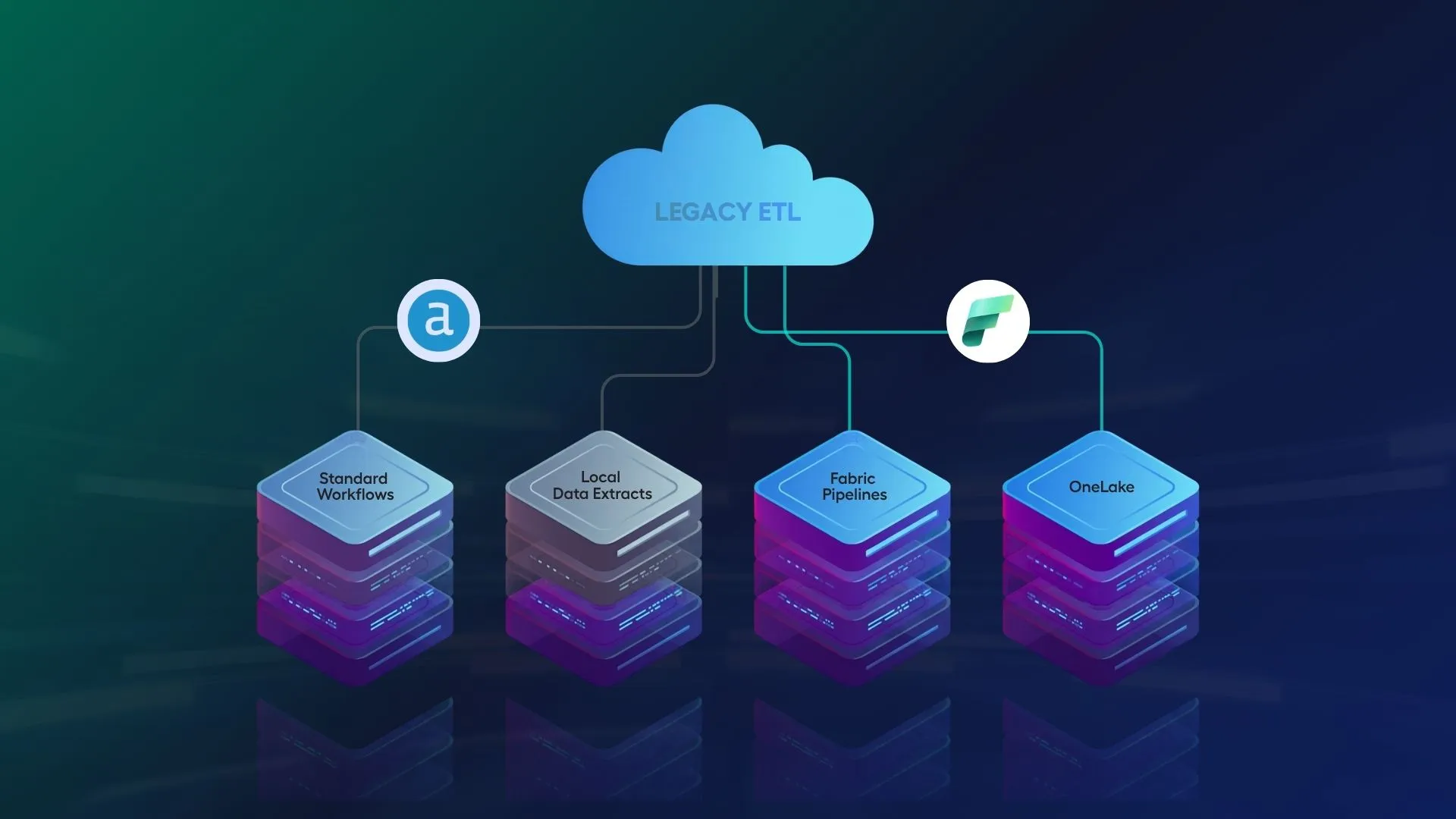
Business owners using legacy desktop bound ETL tools know that it costs a fortune to run them. On top of that if at some point an undocumented workflow breaks that, then that could turn out to be a nightmare for the team.
Moving to a cloud-based analytics platform like Microsoft Fabric is the best decision that a business owner can take. But it is not an easy decision because ETL migrations are complex. Now what makes them complex? Let’s discuss that in this blog
Why Backend ETL Migrations Are Inherently Complex
Backend ETL migrations are not simple IT transfers; these require architectural changes as the backend ETL acts as engine behind tons of organization data and logic.
- Code Trapped in Visual Metadata: Unlike migrating standard software (where you copy code text), legacy ETL tools hide business logic inside proprietary, compiled visual layouts or heavy XML metadata.
- The “Citizen Developer” Dilemma: Alteryx democratized data prep. However, years of unmanaged “shadow IT” have left companies with thousands of workflows lacking documentation, unified standards, or clear ownership.
- Hidden Data Bloat: Explaining that a significant percentage of an organization’s active workflows are duplicates, redundant, or processing data that no one reads anymore.
This complexity can be bypassed by having a strong, expert migration team like Sparity with you.
The Technical Friction: Mapping Alteryx to Microsoft Fabric
The two tools are different in how they function, and hence there is friction during ETL migration. Legacy tools like Alteryx are desktop bound whereas modern tools like Microsoft fabric are cloud native. Alteryx data or reports cannot be migrated to fabric using 1:1 mapping as there are many core differences including field mismatches, different string logic, nested macros, different app UI, etc.
- Architectural Paradigm Shift: Alteryx executes transformations using local node servers whereas Microsoft fabric executes transformations dynamically across shared cloud architectures.
- Field Mismatches: Alteryx formulas and strings do not have 1:1 match with Microsoft Fabric’s spark SQL or Power Query
- Nested & Batch Micros: Alteryx often have multi layered macros that hide their business logic inside workflow dependencies. These are tough to be mapped to Fabric.
- App UI: The UI is different in both the tools and hence data may not be mapped perfectly in Alteryx to Fabric migration.
- Complex components: Advanced Alteryx components such as fuzzy match or spatial analysis require re-authoring via PySpark or custom notebooks.
- Scheduling translation: Alteryx server schedules do not translate to Fabric pipeline triggers automatically
The Strategic Execution Framework (Phase-by-Phase)
ETL migrations can be complex, and that is why you need to have a plan in place for such complex migrations. We have got a strategic execution framework for your ETL migration to go smooth:
Phase 1: Discovery & Inventory
The conversion portal automatically scans your legacy environment to catalogue .yxmd files and track active inputs, outputs, and dependencies. It immediately flags dead, redundant, or obsolete data assets, allowing you to retire them early and establish a clean baseline without weeks of manual checking.
Phase 2: Complexity Tiering
The system evaluates workflow configurations to sort them into Low, Medium, and High complexity buckets. By isolating basic data blending tasks from heavy, multi-layered operations, it allows you to allocate engineering resources accurately and prioritize high-risk pipelines from the start.
Phase 3: Target Architecture Selection
The platform evaluates data volumes and computes needs to route workloads to their optimal home within Microsoft Fabric. It matches legacy logic with the correct cloud component, deciding when to deploy no-code Dataflows Gen2 versus pro-code PySpark notebooks for maximum performance.
Phase 4: Automated Translation & Rebuilding
AI-powered migration accelerators automatically translate metadata maps into cloud-native code, eliminating human transcription errors. The software handles the bulk of formula, join, and filter transformations, converting legacy schedules into Fabric pipelines to cut manual timelines by up to 70%.
Phase 5: Data Parity & Validation
An automated testing engine runs parallel pipelines to guarantee Fabric outputs match legacy results down to the exact row and cell. It performs zero data-touch structural checks and generates detailed discrepancy reports to resolve any variations before the final cutover.
Business Value: What Awaits on the Other Side?
What business value does this migration add to your organization:
- Total Cost of Ownership (TCO) Reduction: Shifting from per-seat licensing to Fabric’s flexible capacity-based cloud model.
- Unified Governance: Consolidating data engineering, warehouses, and frontend Power BI dashboards into OneLake under a single security umbrella.
- AI Readiness: Bridging the lineage gaps of desktop software to create clean data streams that can feed Azure OpenAI and Copilot systems natively.
Conclusion
ETL migrations like moving from Alteryx to Microsoft are more than workflow, or report migrations. You are basically transforming your analytics platform with AI and paving path for accelerated business growth. With the right strategy and automation, organizations can simplify migration using accelerators like SETU for Alteryx to Microsoft Fabric migration.
FAQs
Is Microsoft Fabric an ETL tool?
Microsoft is broader than just an ETL tool. It is a unified analytics tool that includes ETL capabilities.
How can I migrate from Alteryx to Microsoft Fabric?
You can use accelerators like SETU for Alteryx to Microsoft Fabric migration for faster, seamless migration.
Can Alteryx be used for ETL?
Yes, Alteryx is a powerful code-free, desktop bound ETL tool.
What are the key differences between Alteryx and Microsoft Fabric?
Microsoft Fabric is a cloud-native data platform, whereas Alteryx is a self-service data preparation tool.
FAQs