The biggest mistake in an Alteryx-to-Fabric migration is treating it as a purely technical conversion.
Fabric rewards different design principles: distributed execution, immutable storage, medallion architecture, reusable notebooks, and semantic models. None of that maps cleanly onto workflows built under desktop-era constraints, and blind translation can simply re-implement yesterday’s design decisions on more expensive infrastructure.
But there is another side to the argument.
Enterprises facing a hard license-expiry deadline are usually risk-averse, not architecture-idealistic. Given a choice between “lift-and-shift now, re-architect later” and “modernize during migration,” many procurement decisions default to the former. The failure mode of a delayed migration — paying for two platforms or losing access entirely — is often scarier than the failure mode of technical debt.
The right answer is usually a phased plan: get off the sunsetting platform on schedule, then re-architect deliberately.
Migration Should Be Phased Around the Funding, Not Just the Architecture
There is a practical resolution to the tension between lift-and-shift and modernization when looking at an Alteryx to Microsoft fabric migration. When the trigger is license cost, sequencing the migration in two deliberate phases can turn the project from a cost center into something closer to self-funding.
Phase One: Lift and Shift
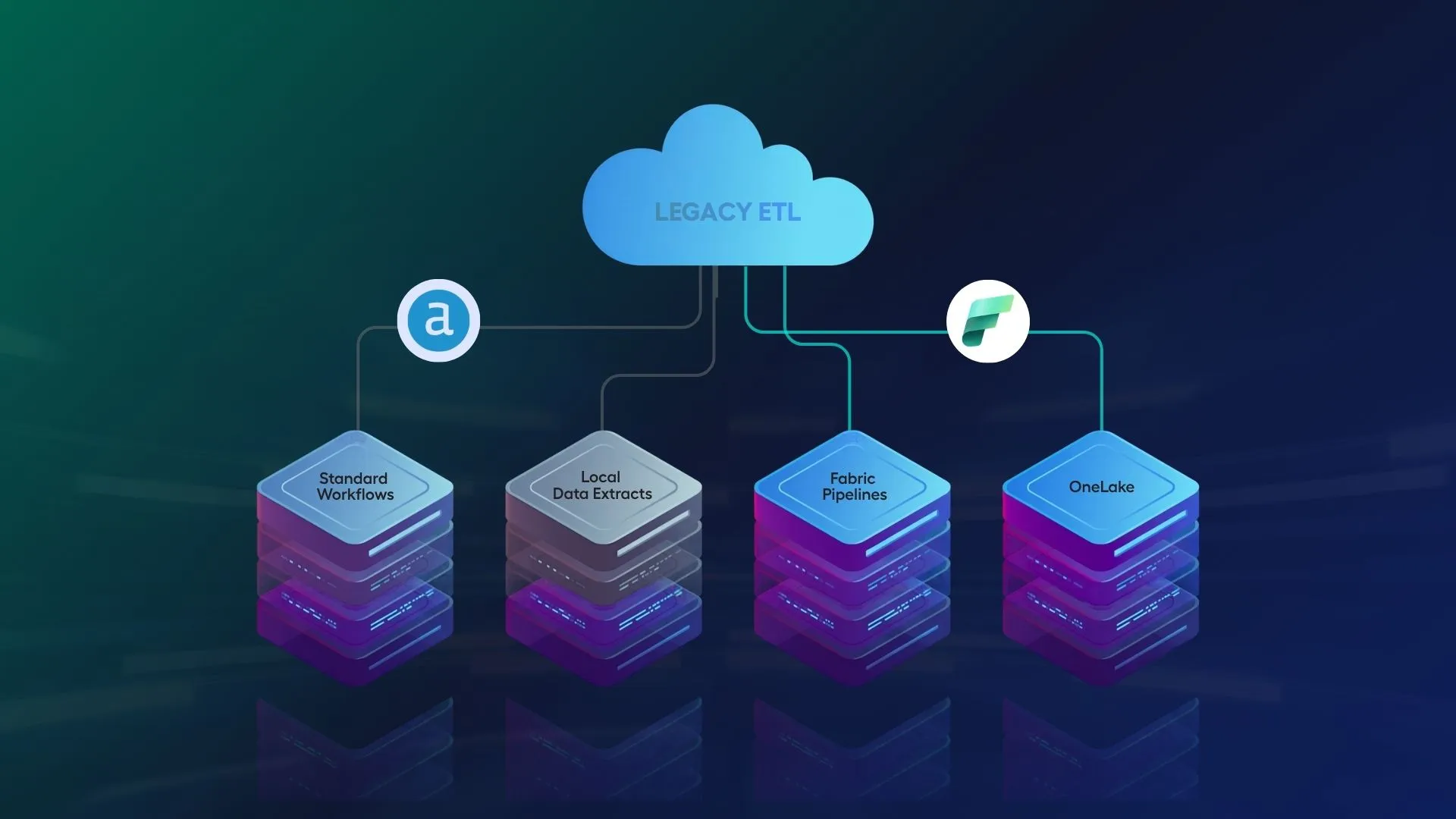
The first phase is a relatively straight lift-and-shift.
Get workflows off the expiring or per-seat-licensed platform and onto Fabric with minimal re-architecture, optimizing for speed and low risk rather than elegance.
The moment that is done, the license bill drops — often immediately and substantially, since desktop/per-user Alteryx licensing doesn’t have a direct equivalent in consumption-based Fabric pricing.
That delta isn’t just a line-item win to report upward. It can become a budget.
Phase Two: Modernization
The savings from phase one can be earmarked to fund phase two: the medallion-architecture, semantic-model, reusable-notebook rework that Fabric rewards but that rarely survives a first budget cycle on its own merits.
This reframes lift-and-shift.
It isn’t necessarily a failure to modernize. It can be a deliberately deferred decision, made explicit and funded rather than left as accumulating technical debt.
It also gives the business a reason to approve the migration in the first place:
Phase one buys the breathing room, and the freed-up budget pays for phase two.
That is often easier to sell than asking for two separate modernization budgets.
Validate Cost and Performance Alongside Correctness
Validation should be a first-class artifact of the migration.
Row counts, checksums, business-rule checks, and statistical comparison should be generated automatically alongside the converted code. The output isn’t simply code but also confidence.
But one dimension is often missing from the validation report: cost and performance.
A converted workflow can pass every row-count, checksum, and statistical-comparison check and still run five times more expensively under Fabric’s consumption-based pricing than the old platform did.
That’s not a hypothetical concern when the migration’s business case depends on license savings funding the next phase.
If correctly migrated workflows quietly consume those savings in compute cost, the self-funding argument collapses before phase two ever gets approved.
Validation therefore needs to answer more than:
Does the migrated workflow produce the same result?
It also needs to answer:
Does it perform efficiently enough to make the migration economically viable?
A checksum-perfect migration that triples compute cost has failed the business case even if it has passed every technical test.
Migration Is Also Organizational Refactoring
Every workflow implicitly answers:
- Who owns this?
- Why does it exist?
- Which KPI depends on it?
- Which downstream reports consume it?
Losing those answers during a platform swap can be a bigger risk than losing the code.
This is real, but it is also exactly the problem data-governance and lineage tooling — Purview, Collibra, and equivalents — already exists to solve.
The interesting question isn’t whether this information matters.
It does.
The question is whether a migration tool should try to build this capability from scratch or integrate with the governance layer the customer probably already has.
But there is a harder version of the ownership question:
Who can maintain this after migration?
A citizen-developer analyst who built a Fuzzy Match → Formula → Filter chain in a drag-and-drop canvas can read it, extend it, and debug it without writing code.
The moment that logic comes out the other side as a PySpark notebook or a set of dbt models, that same analyst can no longer touch their own work.
The knowledge has been preserved.
The authorship model has been destroyed.
There are two honest ways to handle it:
- Invest in a reskilling path so workflow owners can still operate in the target environment — low-code layers on top of Fabric, guided notebook templates, or similar.
- Explicitly accept the dependency and staff a permanent engineering function to own what analysts used to self-serve.
Either is a legitimate choice.
Not naming the choice leaves the most consequential organizational decision in the migration undecided until it becomes a support-ticket backlog six months after go-live.
The Future Product Isn’t Just a Converter
Today’s products sell “80% automated migration.”
The longer-term opportunity is to understand the analytics estate better than anyone else.
That understanding becomes a moat because it is stickier, compounds over time, and is harder for competitors to replicate than a code translator.
But there is an important commercial distinction.
Buyers overwhelmingly buy outcomes, not understanding.
“Migrate us off Alteryx before the license expires” is a project with a deadline and a budget line.
“Understand our analytics estate” is a discovery engagement with a fuzzier ROI and a longer sales cycle.
The estate-understanding capability is the better long-term moat, but it should be built underneath a converter that ships and sells today, not positioned as a replacement for one.
Lead with the outcome the buyer is asking for.
Let the semantic graph, ownership map, and validated business rules be what makes that outcome cheaper and more trustworthy than the competitor’s — and what earns the next engagement after the migration is done.
A Pragmatic Playbook
The argument becomes easier to trust when it turns into concrete moves:
- Triage before you touch anything. Run every workflow through a cheap, automated risk score based on data sensitivity, downstream consumers, and complexity. Don’t excavate 3,000 workflows with the same rigor; find the 200 that matter and put the budget there.
- Discovery produces three outcomes, not one. Migrate as-is, migrate with a business-owner-approved correction, or retire. Build the sign-off step into discovery, not as a separate governance project bolted on afterward.
- Phase the migration around the funding, not just the architecture. Lift-and-shift off the sunsetting platform first. Bank the license-cost delta. Fund the medallion-architecture rework from that delta.
- Validate cost and performance alongside correctness. A checksum-perfect migration that triples compute cost has failed the business case even if it passes every technical test.
- Decide the maintenance model before go-live. Either reskill workflow owners so they can operate in the target environment or explicitly staff the engineering dependency you’ve created.
- Sell the outcome, bank the understanding. Lead with “off the sunsetting platform, on budget, on schedule.” Let the semantic graph, ownership map, and validated business rules be the reason the next engagement is easier to sell.
The practical lesson is simple:
Don’t let the migration’s technical architecture obscure the business decisions that determine whether the migration actually succeeds.
Getting off Alteryx is only phase one.
The real opportunity is to use that migration to reduce technical debt, recover organizational knowledge, validate what still matters, and deliberately modernize what remains. Let Sparity do that for you.
FAQs
Can Alteryx workflows be migrated directly to Microsoft Fabric?
Yes, but direct conversion is not always the best approach. Some workflows benefit from modernization during or after migration.
Should migration be lift-and-shift or a redesign?
For many organizations, a phased approach works better than lift and shift migration.
How does Microsoft Fabric reduce costs compared to Alteryx?
Fabric’s capacity-based model can reduce per-user licensing costs and simplify tooling.
How do you validate a successful migration?
Validate data accuracy, business rules, performance, and compute costs, not just functional correctness.
Will business users need to learn new skills?
Potentially. Organizations should either upskill users or establish engineering support for Fabric workloads.
What is the biggest migration risk?
Treating migration as a code-conversion exercise instead of a business and architecture transformation.
Can migration savings fund modernization?
Yes. Many organizations use licensing savings from migration to fund governance and architecture improvements.
FAQs