
In the past decade, analytics platforms have undergone continuous and tremendous transformation. What once began as static, periodic reporting has evolved into interactive dashboards, near real-time analytics, and AI-assisted insights. Today, organizations expect their data platforms to be faster, smarter, and more responsive than ever before to win the competition.
But there is a fundamental limitation in the path towards success!
Most data platforms are excellent at understanding data structures, but lag at understanding business meaning.
They know what a table looks like, how columns relate and how to aggregate, filter, and visualize. But these data platforms don’t understand why the data exists, how it connects to real-world business processes, or what decisions should logically follow when conditions change.
This is the gap that Fabric IQ is designed to address.
Fabric Intelligence Quotient
Fabric IQ represents a significant architectural shift within Microsoft Fabric, a move from being a unified analytics platform to becoming an intelligence-driven system that understands context, semantics, and intent. It is an attempt to rethink how data platforms reason, respond, and act in modern enterprises.
From Data Access to Data Understanding
Most analytics evolution has focused on access:
- Faster queries
- Larger datasets
- Real-time streams
- More dashboards
Fabric IQ focuses on something more subtle but far more powerful: understanding.
- Understanding who the customer is, beyond a customer ID.
- Identifying how sales, inventory, logistics, and operations influence one another.
- Determining which actions are valid, safe, and meaningful in each business context.
This shift from access to understanding is what separates Fabric IQ from earlier generations of analytics capabilities.
Table of Contents
Fabric IQ vs. Retrieval-Augmented Generation Models
The RAG works by identifying relevant documents and using them as a context for generating responses. This model is widely used by companies since it improves factual accuracy compared to language models. But it lacks reasoning.
Fabric IQ on the other side builds a semantic graph that represents- business entities, relationships between entities, organizational structures, workflows, and business rules and constraints. Fabric IQ understands how suppliers relate to products, regions, costs, and delivery timelines. It understands how customer regions map sales performance and how production planning impacts inventory availability.
Semantic Intelligence in Power BI
Nearly a decade ago, semantic models were introduced into the Power BI ecosystem. These models allowed organizations to define entities, relationships, and measures that reflect business logic rather than just raw data structures.
For business intelligence departments, this was a major step forward. Analysts could work with familiar concepts instead of relying on table names. Reports became more consistent and accessible.
However, these semantic models had clear limitations as they were confined to BI and visualizations use cases, did not extend naturally into operations or AI-driven decision-making, and operated with individual datasets.
How Ontology will reshape enterprise AI strategy
At the heart of Fabric IQ lies its most important concept: Ontology.
Ontology in simple terms is the business vocabulary that defines core business entities such as customers, products, assets, or transactions. It understands the relationship between entities, constraints, and objectives. Fabric IQ takes a different route enabling enterprises to move beyond just scaling compute or fine-tuning models.
This semantic layer operates independently of physical data entities, enabling organizations to model business concepts and processes without being constrained by the underlying table structures or file schemas in Fabric Lakehouse and Data Warehouse.
Integrated Capabilities That Power Fabric IQ
Fabric IQ is not a single feature. It is a coordinated set of capabilities designed to work together:
- Ontology: A shared model defining business entities, relationships, rules, and objectives.
- Semantic Models: Trusted BI definitions extended beyond reporting into AI and operational workflows.
- Graph Engine: A native graph capability that enables multi-hop reasoning across systems and domains.
- Data Agents: Virtual analysts that interpret business meaning and answer questions in natural language.
- Operations Agents: Autonomous agents that monitor real-time signals, reason with context, and take governed actions.
Together, these components allow Fabric IQ to function as an intelligence layer rather than a reporting layer.
Key applications of Microsoft Fabric IQ
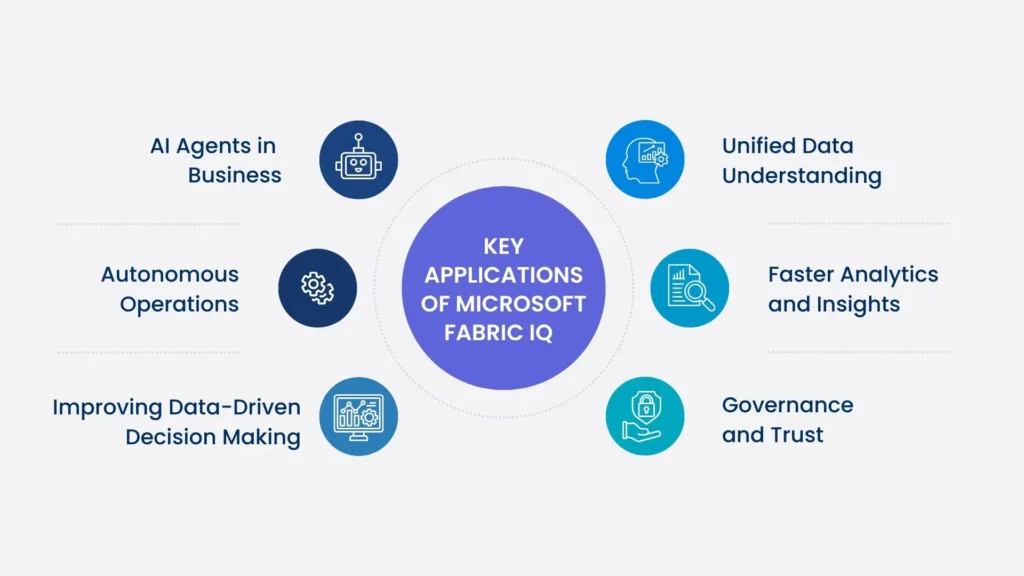
- AI Agents in Business: Fabric IQ’s core component, the Ontology, provides a structured map of business entities, relationships, rules, and actions. This leads to more accurate, and explainable responses and actions, thereby reducing AI hallucinations.
- Autonomous Operations: Through Operations Agents, Fabric IQ continuously monitors real-time data for defined conditions or rule breaches, such as traffic delays or low inventory levels, and automatically triggers appropriate actions or alerts to support business objectives.
- Improving Data-Driven Decision Making: It enables a consistent semantic layer across tools and users removes conflicting definitions and ensures both people and AI systems rely on a trusted version of business data.
- Unified Data Understanding: Fabric IQ connects data from diverse sources across the enterprise like OneLake, Power BI semantic models, real-time data streams, and external data sources into a single, cohesive view, that enables cross-domain reasoning and deep insights.
- Faster Analytics and Insights: By providing a structured view of the business, Fabric IQ simplifies data access and analysis, allowing for faster development of new analytics experiences. This helps organizations shift from reactive reporting to proactive and predictive insights.
- Governance and Trust: Centralized business rules and constraints enhance data quality, strengthen governance, support lineage tracking, and help organizations meet compliance requirements across their data landscape.
Conclusion
Fabric IQ is about redefining how existing analytics tools work together. Ontology in Fabric IQ allows analytics, AI, and operations to share a common understanding of the company.
Fabric IQ moves enterprises closer to systems that do not just analyze data but understand the business behind it. In the evolution of analytics, this is less a feature upgrade and more a philosophical change, one that signals the beginning of thinking systems rather than reporting systems.
At Sparity, we have seen similar challenges across past modernization initiatives where fragmented definitions, disconnected data models, and limited context slowed both analytics and AI adoption.
Our experience in designing semantic models, aligning business logic with data platforms, and enabling governed, enterprise-wide analytics has consistently helped organizations move from isolated insights to unified intelligence. Fabric IQ builds naturally on these foundations, and Sparity is well-positioned to help enterprises adopt it with clarity, confidence, and measurable impact.