A unified semantic layer is a centralized translation layer that sits between your raw data and every tool that consumes it. It defines metrics, business logic, and relationships once so every team, dashboard, and AI model works from the same definitions. It is the foundation of a true single source of truth.
What is a Semantic Layer?
It is a business abstraction layer that maps raw database tables and fields into human-readable metrics, dimensions, and KPIs without moving or duplicating the underlying data. It translates technical data structures into business language that every team and tool can understand and use consistently.
Difference Between a Semantic Layer and a Unified Semantic Layer
Most organizations already have semantic layers they are just fragmented across Tableau, Power BI, dbt, Looker, and individual spreadsheets. A unified semantic layer consolidates all of these into one centralized definition layer so that it is readable by every tool and trusted by every team.
When your Tableau workbook calculates churn one way, your dbt model calculates it another, and your data science team has a third version in Python. This indicates that the team has three semantic layers pretending to agree with each other. Unification involves collapsing all of this into a single governed layer.
Why are companies moving to Unified Semantic Layer?
Most Business Intelligence tools allow users to define their own semantic models. But it is necessary for businesses to have a common representation of data so that different teams in the enterprise can access the data using common business terms. Creation of a unified semantic layer helps business users to access the information irrespective of the BI tool they use. This means that they can work on Excel, Tableau, Looker or any other tool they feel convenient and access the same semantic model.
What Lives Inside a Unified Semantic Layer?
A unified semantic layer is a structured collection of centralized business definitions that are created once and shared consistently across every analytics, BI, AI, and operational tool in the organization. Rather than maintaining separate semantic models inside individual platforms, a unified semantic layer governs and distributes one common understanding of the business.
Entities & Objects
Core business concepts defined once and reused across dashboards, applications, APIs, and AI systems.
Metrics & Measures
Each metric has one approved definition that is consumed consistently across every reporting and analytics environment.
Dimensions & Hierarchies
Shared dimensions available across all connected tools instead of recreated independently within each platform.
Business Logic & Rules
Business definitions are governed centrally so every consumer applies the same logic automatically.
Relationships & Joins
Join logic is maintained once and propagated everywhere rather than rebuilt per dashboard or model.
Governance & Access Controls
Security, access policies, and compliance rules are enforced consistently across all consuming systems.
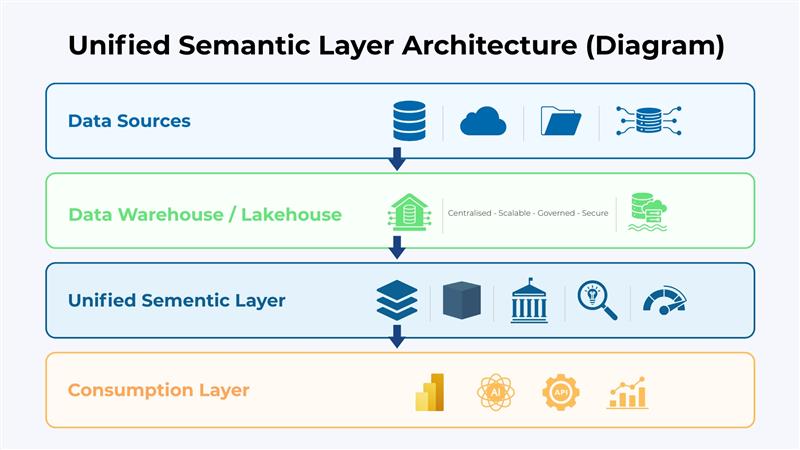
Business logic is centralized once and consumed everywhere.
How Does a Unified Semantic Layer Break Data Silos?
Breaking data silos starts with a cultural shift, leadership involvement and technological investments for cross-department collaboration and data-sharing. In order to break the data silos implementation of unified data platforms with consistent data management and data governance standards across the company is required. The first proven solution would be perhaps to implement the semantic layer that address the problem of data silos by providing a unified – one source of truth- and friendly abstraction over different data sources.
There are three distinct types of silos it addresses:
Organizational Silos
Finance, Marketing, and Product all aligned on one definition. No more Monday morning metric debates.
Technical Silos
BI tools, APIs, reverse ETL, and AI models all consume one layer. Fix logic once; every system benefits.
Semantic Silos
“Our churn” vs. “your churn” stops being a debate. One definition, is universally referenced.
The compounding effect is significant. As teams adopt the unified semantic layer, trust in data grows. As trust grows, the volume of “can you check this number?” requests drops. As those requests drop, the data team shifts from being a number-checking service to being a strategic analytics function. This is the flywheel that makes the investment worthwhile.
According to Gartner, poor data quality costs organizations an average of $12.9 million per year and much of that cost stems from inconsistent definitions across teams. The rise of self-serve analytics, AI/ML pipelines, and embedded analytics has raised the stakes further: AI models consuming data without business context will produce confident answers based on the wrong definitions.
The shift happening now is from tool-centric architecture (each tool defines its own logic) to definition-centric architecture (one layer defines logic for all tools). That shift is the unified semantic layer.
Key Benefits of a Unified Semantic Layer
- Establishes a Single Source of Truth
Unified Semantic Layer creates one governed definition for business metrics so every dashboard, report, and team works from the same numbers reducing inconsistencies and decision friction.
- Enables Self-Service Analytics
Allows business users to explore and analyze data using familiar business language without relying heavily on technical teams or rebuilding logic.
- Strengthens Data Governance
Applies security policies, access controls, and compliance standards centrally, so governance remains consistent across all connected platforms.
- Improves AI and Analytics Readiness
Provides AI models and analytics tools with consistent business context and standardized metadata helping improve reliability and reduce interpretation errors.
- Reduces Operational and Infrastructure Overhead
Minimizes duplicated transformation logic and improves query efficiency through centralized definitions, helping optimize performance and manage compute costs more effectively.
A Step-by-Step Approach to build a Unified Semantic Layer
Building a unified semantic layer is not a purely technical exercise. It is as much an organizational initiative as an engineering one. Here is the roadmap practitioners actually use:
1. Discover – Audit Existing Definitions
Inventory metrics, dimensions, business rules, and data logic across dashboards, BI tools, data models, spreadsheets, and documentation. Identify duplicates, inconsistencies, ownership gaps, and the metrics that generate the most debate.
2. Align – Agree on Shared Business Definitions
Collaborate Finance, Marketing, Product, Operations, and Data teams together to establish one approved definition for each critical metric and business concept. Document assumptions, exclusions, and calculation methods so decisions remain repeatable over time.
3. Centralize – Move Logic into the Semantic Layer
Translate approved business definitions into the semantic layer and remove duplicate logic from dashboards, notebooks, and reporting tools.
4. Govern – Establish Ownership and Quality Controls
Assign a named owner to every metric and definition. Implement version control, testing, approval workflows, and monitoring to prevent definition drift and maintain trust.
5. Activate – Connect Every Consumption Layer
Integrate BI platforms, APIs, AI applications, embedded analytics, and self-service reporting with the semantic layer so all consumers operate from the same governed logic.
6. Iterate – Treat the Semantic Layer as a Product
Business definitions evolve. Establish a formal change management process with reviews, versioning, communication, and release cycles to keep the semantic layer aligned with business change.
What Are the Most Common Mistakes When Implementing a Semantic Layer?
- Trying to model everything at once. The scope becomes unmanageable and the project stalls. Start with the 10 most-contested metrics in your organization. Prove value. Then expand.
- Choosing the tool before agreeing on definitions. The platform decision is secondary. If teams cannot agree on what “active user” means, no tool will solve that. Alignment comes first, tooling second.
- No metric ownership model. Every metric in the semantic layer must have a named owner, a person, not a team. Without ownership, definitions drift, and the layer becomes as fragmented as what it replaced.
- Treating adoption as automatic. The semantic layer needs champions in every business team, not just engineers who built it. Documentation, training, and internal advocacy are not optional they are the activation strategy.
- Skipping versioning and change management. Definitions will evolve as the business evolves. Without a formal change process, well-intentioned updates silently break downstream dashboards and reports.
The importance of a unified semantic layer will only grow as organizations move toward AI-first decision-making, self-service analytics, and increasingly distributed data ecosystems. Today, the challenge is ensuring every system interprets that data the same way.
As BI platforms, AI agents, embedded analytics, and operational applications continue to multiply, organizations should not neglect business logic scattered across dozens of tools. The next generation of data architecture will be built on shared definitions, governed context, and reusable business meaning.
FAQ’s
1. Is a unified semantic layer replacing a data warehouse?
No. A data warehouse stores and processes data, while a unified semantic layer standardizes how that data is defined and consumed across tools.
2. Does a unified semantic layer improve AI outcomes?
Yes. By providing consistent business context and governed definitions, it helps AI and analytics systems generate more reliable outputs.
3. How long does it take to implement a unified semantic layer?
Implementation timelines vary based on data maturity, but most organizations start with high-value metrics before scaling gradually.
4. Who should own a unified semantic layer?
Successful implementations are typically jointly owned by data teams and business stakeholders to ensure both technical consistency and business alignment.
FAQs