
The healthcare and pharmaceutical industries are among the busiest sectors, where the inflow of data never pauses. The global pharma market is expected to grow by $2.2 Trillion by 2029, reaching a market volume of US$1,454.00 billion. According to the OECD, hospitals handle 1 billion inpatient admissions annually, along with 3–5 billion outpatient and emergency visits. This highlights the staggering volume of EHRs, prescriptions, imaging, claims, and lab results generated daily.
The Healthcare Data Explosion: Why Legacy Systems Fail
Considering this massive data influx, manual check-ins lead to hours wasted per patient. Fragmented prescription data and siloed systems delay treatment, creating compliance risks and missed insights. Legacy on-premises data warehouses in hospitals and pharma struggle with EHR interoperability, real-time patient risk scoring, and genomic-scale datasets from wearables and sequencers.
To address this, healthcare and pharma companies worldwide are adopting Databricks Lakehouse to bring order to the chaos, unify healthcare architecture into scalable, AI-ready platforms, and maintain compliance. By consolidating siloed data into a single, compliant environment, organizations can analyze structured EHRs, unstructured clinical notes, and genomic data, turning fragmented information into actionable insights.
Table of Contents
The Data Intelligence Platform by Databricks
A major challenge for pharma industries is tracking scientific information faster than the pace at which they grow. This created an urgent need for a platform that could build high-performing data pipelines feeding machine learning models designed to help scientists make targeted decisions.
The Databricks Data Intelligence Platform was developed to leverage data and machine learning to build recommendation engines for scientists. It is fast, cost-effective, and efficient.
Here are some of the use cases of Data Intelligence Platform-
- Personalization with patients, members and healthcare professionals is improved through holistic approach.
- Operational efficiency is achieved by rapidly ingesting data from anywhere and enabling real-time analytics.
- Increase in productivity levels by bringing intelligence to every team member across the patient journey
- Helps in discovering novel therapeutics by unlocking the power of machine learning and AI
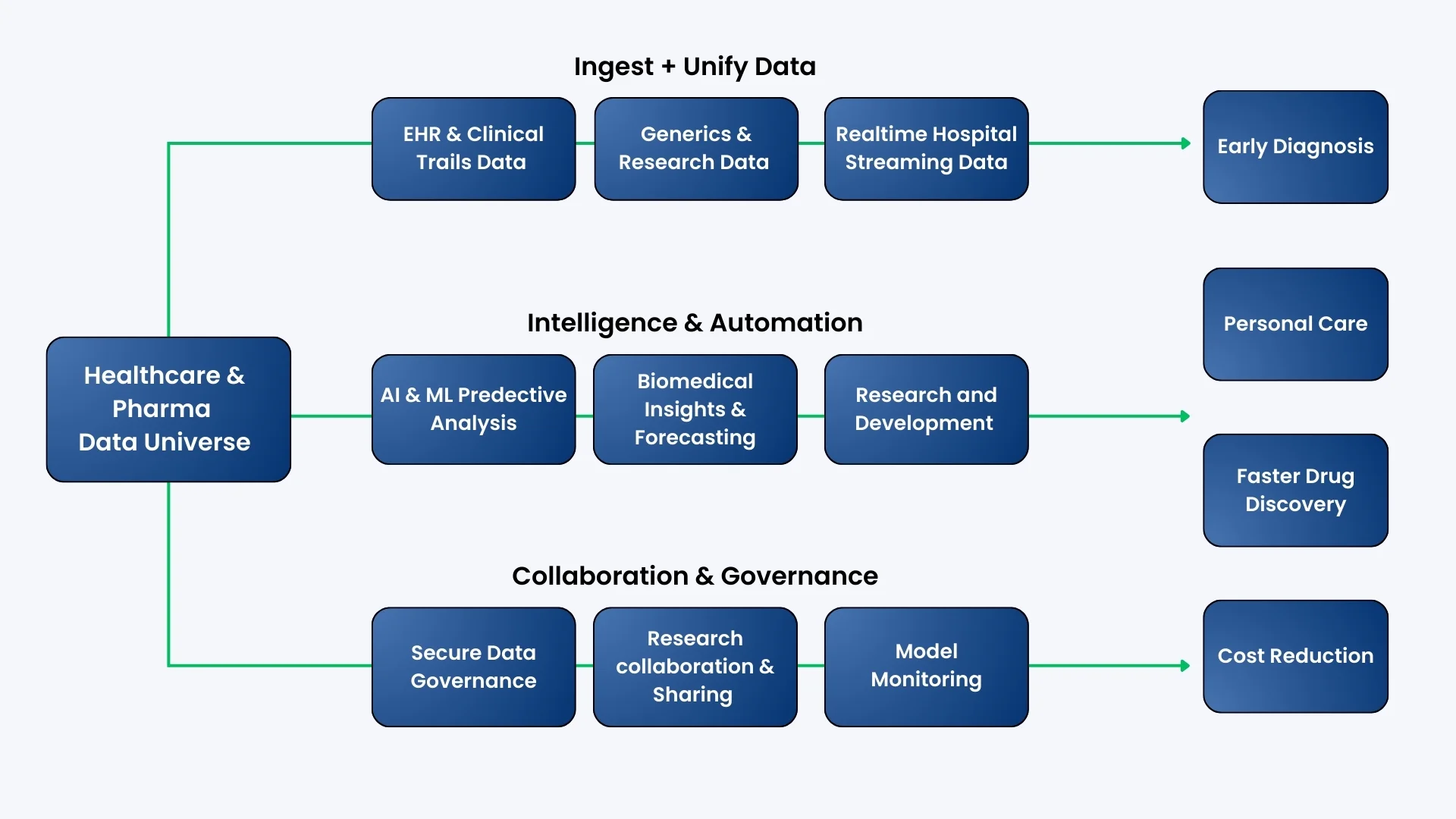
Key uses cases of Databricks
Let’s look at some of the main advantages that Healthcare and Pharma industry has benefitted from-
Drug Discovery & Development-
Developing new drugs takes around 10–15 years and over $5 billion in R&D investment, with only 5% of drugs making it to market. Also, once a drug or medical device is released, it’s important to keep track of any side effects or problems. AstraZeneca, for example, has adopted a data-driven approach to increase success rates and enable quicker, safer clinical trial management.
Databricks simplifies cluster management and maintenance of analytic resources at scale. It leverages NLP (Natural Language Processing) across vast scientific literature and data sources for downstream analysis. Additionally, machine learning innovation allows data scientists to build and train models efficiently, making it easier to rank predictions and make smarter decisions.
Predictive Analytics for Disease Outbreaks
Healthcare organizations and public health agencies can use Databricks to analyze large, diverse datasets patient records, epidemiological data, mobility and environmental data, social media, and more to forecast disease outbreaks and trends. The platform’s ability to unify batch and streaming data enables near real-time dashboards and alerting systems.
Real-Time Patient Risk Stratification
Risk stratification is essential for identifying patients at high risk of deterioration, readmission, or complications. Databricks supports structured streaming pipelines that bring together real-time vitals, EHR signals, monitoring device data, and historical records. Machine learning models trained on historical cohorts can score risk continuously and trigger alerts for care teams.
Predictive Hospital Operations
Many hospitals struggle to balance capacity and demand across operating rooms, ICUs, step-down units, and emergency departments. Databricks enable time-series and forecasting models that use historical admissions, seasonal patterns, staffing rosters, and local events data to predict OR demand, ICU capacity needs, and ED inflows. With these predictions, hospitals can optimize staff scheduling, reduce idle resources, improve patient throughput, and increase bed turnover while maintaining quality and safety.
Clinical Trial Optimization-
Clinical trials are complex and costly, with recruitment and retention being persistent bottlenecks. By leveraging patient demographics, historical trial data, eligibility criteria, EHRs, and claims, organizations can use Databricks to:
- Optimize trial site selection
- Identify eligible participants across diverse populations
- Forecast enrollment timelines and identify risks early
Databricks streamlines data preparation for protocol design and enables analytics teams to iterate faster. Integrated ML capabilities help score likelihood of enrollment and adherence, leading to more efficient trials and higher-quality evidence.
Transforming Patient Data Analytics
The primary goal of using advanced data platforms like Databricks in healthcare is to improve patient outcomes. Databricks empower organizations to transform raw data into actionable insights that drive better clinical decisions.
By aggregating data from clinical visits, remote monitoring devices, and patient feedback channels, healthcare providers can develop a comprehensive understanding of patient health trends. This holistic perspective facilitates proactive care management, tailored treatment plans, and the near real-time identification of emerging public health issues.
Conclusion
As healthcare and pharma data volumes continue to surge, the organizations that will lead the next decade are those that consider platforms like Databricks as strategic enablers for precision medicine, operational excellence, and AI-driven care delivery. The convergence of real-time streaming data, multimodal AI, and synthetic patient data will make it possible to predict risk earlier, personalize therapies, and compress drug discovery timelines from years to months. The real competitive differentiator will be how quickly and responsibly enterprises can industrialize these capabilities at scale.
How Sparity Can Help
Sparity helps healthcare providers and Pharma Companies turn Databricks into that strategic data intelligence layer. With deep experience across Databricks Lakehouse, Delta, Unity Catalog, Databricks SQL, and MLflow we design and implement solutions tailored to clinical, operational, and R&D needs.
By combining modern data engineering with healthcare and pharma domain knowledge, we moves organizations beyond pilots and proofs-of-concept toward robust, production-grade data intelligence platforms. If your goal is to unlock the full value of your EHR, claims, and research data with Databricks, Sparity can be your end-to-end partner from strategy and architecture through implementation and ongoing optimization.