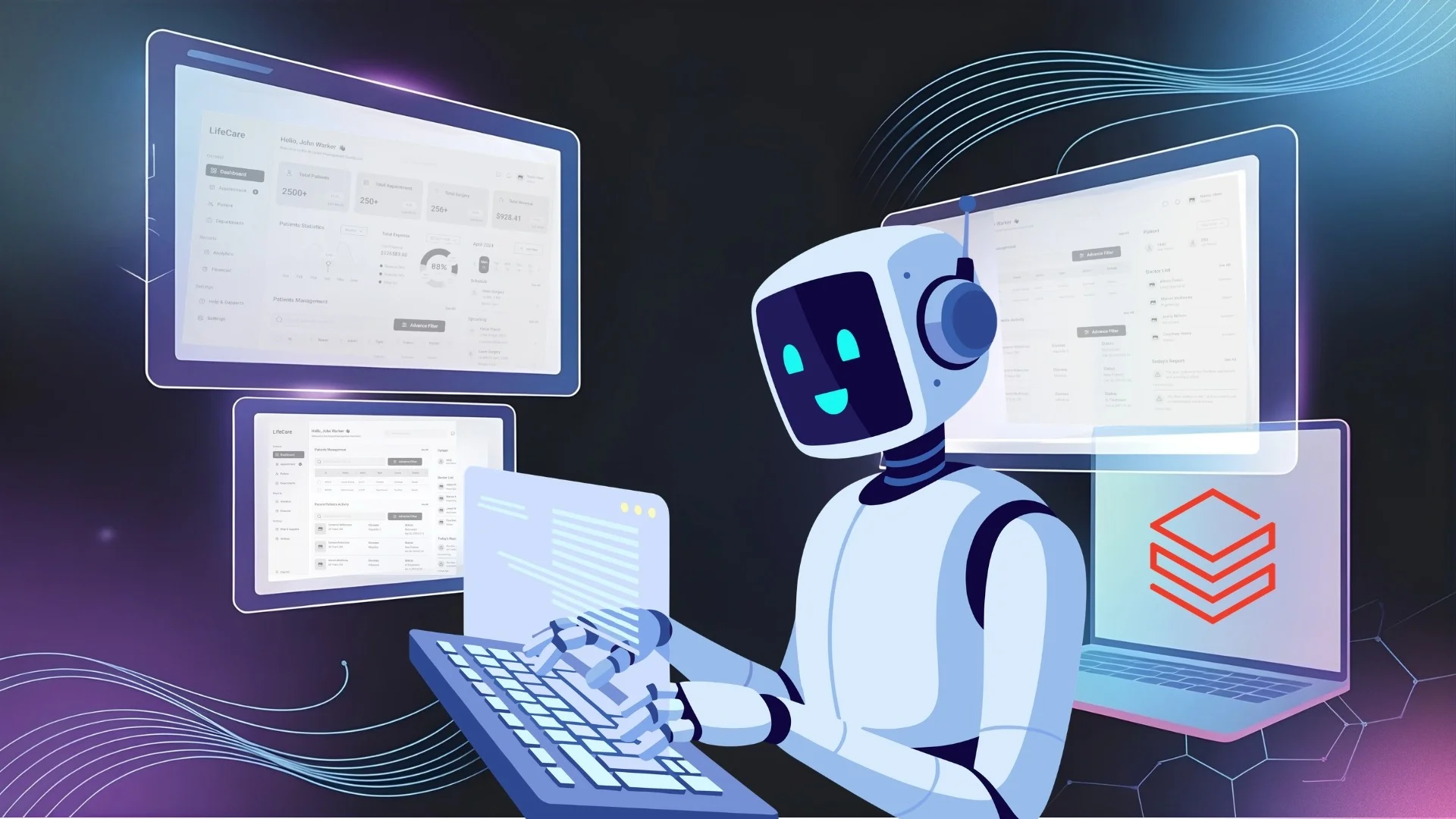
With the rise of agentic AI on Databricks, organizations are moving away from, human-triggered workflows toward systems that can reason, plan, and act autonomously. This transition is quietly reshaping how automation, databases, and even software development are approached at scale, signaling a deeper architectural change.
A recent report from MIT Technology Review shows that 67% of organizations already use AI-powered tools. Additionally, more than half of business leaders view agentic AI as a multiplier for operational performance and decision-making. In fact, the usage data collected across Databricks platform, from more than 20,000 organizations across the world, indicates enterprises are moving beyond single purpose chatbots towards multi-agent systems that can coordinate, plan, reason and execute workflows autonomously.
Recent activity proved that the usage of multi-agent systems grew 327% in just four months. The pressure is clearly visible in the database layer as the AI agents also create 97% of the database branches, cutting the time required to clone/rewind the environments within seconds.
A Database for the Agentic AI Era
Databricks has been ranked third in enterprise data warehousing adoption, with roughly 15% penetration among relevant organizations. In addition, Gartner also estimates that by 2028, 90% of the enterprise software engineers will use AI code assistants, which was just 14% in 2024.
Database is no longer just a place to store rows; it has indeed evolved into a unit of persistent memory and coordinated layer for multi-agent systems.
Table of Contents
AI agents – Architecture outlook
Vibe coding is the new term that has gained wide popularity, this AI-driven approach to application development has quickly overhauled how companies handle their databases. This has created an urgency for companies to deliver the elasticity and programmability in their architecture needed for AI agents. A recent example from Neon, a serverless Postgres database acquired by Databricks and the core technology behind Databricks Lakehouse, it has been found that AI Agents now create 80% of all databases and 97% of database branches.
Databricks- The Platform for Agentic AI
Databricks provides a unified data + AI stack a crucial foundation for building enterprise AI agents that are not powerful, governed, observable, and composable.
Key enablers are:
- Unity Catalog: Agents can access the data they need while enterprises have strict control and oversight over the accessibility of the confidential data.
- MLflow: Here, Agents have control over lifecycle management, observability and tracing to log and monitor every inference call, prompt and toll invocation.
- Mosaic AI: Extends the Lakehouse into a native runtime for agentic AI, with models, retrieval, and evaluation integrated at the platform level.
The above components enable enterprises to design agentic systems as production-grade architectures aligned with the Databricks Agentic AI Framework.
Major Building Blocks of Agentic Systems
The effectiveness of agentic systems depends on reliable retrieval, reasoning, orchestration, memory, and monitoring. Databricks delivers these capabilities natively, unified through the Lakehouse and Unity Catalog.
1. Mosaic AI: Vector Search
At the core of any context-aware agent is its ability to find the right information at the right time. Databricks Vector Search acts as a semantic search layer that turns enterprise data into a living, searchable memory that AI agents can use in real time, rather than relying on static or outdated knowledge.
• Indexing: Enterprise data including documents, structured tables, PDFs, support tickets, and transcripts is converted into embeddings using trusted models such as BGE, open-source options, or Databricks foundation models like DBRX.
• Querying: When an agent receives a request, the query is translated into the same semantic format and matched against the most relevant information using similarity techniques.
• Fine-Grained Security: All vector indexes inherit Unity Catalog access controls, ensuring that agents only retrieve data they are authorized to see. This prevents cross-domain exposure, keeps customer data isolated, and enforces role-based boundaries across the organization.
• Integration: Retrieved results can be directly fed into AI prompts from Databricks notebooks, MLflow-managed models, or automated workflows. This supports complete Retrieval-Augmented Generation pipelines, where agents consistently ground their responses in approved, up-to-date enterprise knowledge.
2.Foundation Models for Cognition
At the enterprise level, agentic AI needs more than language generation. It needs the ability to understand intent, reason through problems, and plan actions across multiple steps. Databricks supports this by offering a curated set of foundation models, including DBRX and leading open-source models such as LLaMA 2. These models are delivered through managed endpoints and integrated with MLflow, making them reliable, governable, and ready for production use.
• Hosted Models: Organizations can easily run inference using DBRX or open-source models through managed MLflow deployments. This removes the burden of managing infrastructure while enabling teams to scale AI workloads securely and consistently across environments.
• Prompt Engineering: Reusable prompt templates allow teams to combine instructions, user input, and retrieved enterprise context in a structured way. Versioning and tracking through MLflow helps enterprises maintain consistency, improve quality over time, and reduce risk as prompts evolve.
• Multi-turn Support: By storing conversational state using Delta tables or MLflow memory, agents can maintain context across interactions. This enables more natural conversations and better decision-making, especially in workflows that require continuity, approvals, or follow-up actions.
• Streaming Inference: Streaming responses improve the experience for interactive enterprise applications by reducing response time and keeping users engaged.
• Fine-Tuning: Domain-specific fine-tuning helps align models with enterprise requirements such as compliance standards, internal terminology, and brand voice.
3. Decision Making and Orchestration
Agents must do more than reason. At the enterprise level, they must take action across systems in a controlled and auditable way. Mosaic AI, integrated with Databricks Workflows, provides the orchestration layer that allows AI agents to execute tasks, coordinate tools, and manage multi-step decisions across enterprise environments. This layer is essential for building production-ready agentic AI on Azure Databricks.
• Function Registry: Enterprise teams can register Python functions or SQL operations in Unity Catalog and expose them as reusable, governed tools. Each function is schema-validated and centrally managed, allowing agents to safely perform actions such as retrieving invoices, checking system errors, or triggering downstream processes.
• Workflow Tasks: Databricks Workflows enable agents to follow structured, multi-step flows such as calling an API, validating business rules, summarizing outcomes, and writing results to Delta tables. Every step is logged and observable, giving enterprises full visibility, traceability, and control over agent behavior.
• Dynamic Tool Calling: Mosaic AI supports common agent orchestration patterns where agents decide which tools to use based on the situation. Whether using planner-executor loops or multi-agent coordination frameworks, agents can dynamically select and invoke the right tools as their reasoning evolves.
• External Integrations: Agents can securely interact with external enterprise systems like Salesforce, ServiceNow, or custom microservices. Built-in support for retries, idempotency, and failure handling ensures reliability and resilience when operating across distributed systems.
4. Memory & Recall
Agents need memory to operate effectively over time. Without it, every interaction starts from scratch. Mosaic AI supports a layered memory approach that allows agents to combine short-lived context with long-term recall, enabling more consistent and intelligent behavior across enterprise use cases.
• Short-Term Memory: During a single task or interaction, agents retain intermediate reasoning steps, tool outputs, and conversational context. This information is typically stored in workflow-level caches or tracked through MLflow spans, helping agents reason step by step without losing context mid-task.
• Long-Term Memory: Important historical information such as previous incidents, user preferences, or key business metrics can be stored in Delta Lake tables or vector databases. This gives agents the ability to recall past events and apply that knowledge to future decisions.
• Embedding Memories: Operational data like system logs, ticket updates, or performance metrics can be converted into embeddings. This allows agents to retrieve relevant past information based on meaning, not just exact matches, even across long time periods.
• Context Injection: When an agent starts a new task, relevant memory is retrieved through Vector Search and added to the prompt at runtime. This ensures the agent maintains continuity in reasoning across days, weeks, or months rather than responding in isolation.
5. Monitoring, Governance & Agent Ops
Without visibility and guardrails, agentic AI becomes difficult to trust and even harder to scale. Mosaic AI addresses this by embedding AgentOps capabilities directly into the Databricks platform, giving enterprises the monitoring, evaluation, and governance they need to run AI agents safely in production.
• Prompt Tracing: Using MLflow tracing and Unity Catalog event streams, teams gain end-to-end visibility into how agents make decisions and take actions.
• Toxicity & PII Filters: Built-in moderation layers can flag, redact, or block responses based on enterprise policies, ensuring agents comply with data protection and usage standards.
• Cost & Token Tracking: Tracking usage per agent, task, or tenant helps control spend, optimize performance, and support internal chargeback or reporting models.
• Observability Dashboards: Teams can create dashboards that show how agents perform in real scenarios, including success rates, replanning frequency, tool failures, and adherence to service-level expectations.
• Evaluation Framework: Before changes reach production, agents can be tested using benchmark tasks, regression checks, and human reviews.
Why enterprises are moving to agentic AI
Enterprises are reaching a breaking point. Data volumes are exploding, systems are multiplying, and decision cycles are getting shorter, yet most organizations are still relying on dashboards, scripts, and human-triggered workflows to keep operations moving. These approaches were designed for a slower, more predictable world. Today, they create bottlenecks. Insight arrives too late, actions depend on manual handoffs, and complexity quietly erodes speed and accuracy.
Agentic AI is emerging as a response to this reality. It represents a shift from automation that waits for instructions to systems that can sense, reason, and act on their own. Instead of asking people to constantly interpret data and decide the next step, enterprises can deploy agents that monitor signals, retrieve the right context, plan actions, and execute workflows continuously. This is not about replacing humans, but about removing friction from decision-making at scale.
Conclusion
At Sparity, we help organizations translate this architecture into production-ready agentic AI solutions on Databricks. From designing governance-first agent frameworks to accelerating deployment and operationalization, we work with enterprises to move confidently from experimentation to impact. As agentic AI becomes central to how modern organizations operate, the ability to implement it responsibly and at scale will define the next phase of enterprise transformation.