Healthcare organizations generate an abundance of data in various forms, including clinical, operational, financial, quality, and compliance data. However, many healthcare leaders continue to depend on inefficient methods for obtaining the data they need to make decisions, including manually extracting data from different systems, using spreadsheets, and waiting for reports to be generated.
Through healthcare data modernization, automation, standardization of analytics and reporting, and self-service report creation, organizations can reduce reporting cycles by up to 70%. The greatest benefits are realized by healthcare organizations that transition from manually creating reports in a retrospective manner to an integrated automated platform.
Key Discussion Points in this blog:
- The inefficiencies in healthcare reporting
- The effects of report delays on business operations
- The strategies and interventions undertaken by healthcare organizations to improve reporting
- A pathway and blueprint for healthcare leaders to modernize data, analytics, and reporting in their organizations
The Reporting Challenge in Healthcare
Various stakeholders in healthcare depend on reports for their work status. Healthcare modernization starts with solving the reporting challenge.
| Stakeholder | Reporting Needs |
| Executives | Operational, financial, strategic KPIs |
| Clinical Leaders | Quality measures, outcomes, utilization |
| Compliance Teams | HIPAA, regulatory, audit reporting |
| Finance Teams | Revenue cycle and reimbursement reporting |
| Population Health Teams | Risk stratification and care gaps |
Most organizations maintain data across:
- Electronic Health Records (EHRs)
- Revenue Cycle Management systems
- Laboratory systems
- Imaging systems
- Population health platforms
- Claims systems
- Excel-based departmental reports
As a result, analysts and data integrators in healthcare spend a lot of time integrating data. Manually extracting data in healthcare creates reporting and analysis of bottlenecks, and slowdowns in decision-making. There is a low level of confidence in metrics, and the reports are often deemed unreliable.
The Hidden Costs of Traditional Reporting
Typically, traditional reporting environments results in:
Siloed Data – Finance, clinical, and operational data reside in disparate systems, requiring manual reconciliation.
Labor Intensive Reporting – Analysts manually:
- Extract data
- Clean data
- Validate data
- Build reports
- Distribute reports
A healthcare modernization project documented analysts spending 15-20 hours per week performing manual reporting activities before automation.
Delayed Decision-Making
Reporting activities can consume the time required to take necessary action, and the window of opportunity may be lost. Increasingly, leaders considering healthcare analytics modernization emphasize the use of intelligence to inform action, rather than reporting for historical purposes.
Why 70% Reduction Is Achievable
70% reporting reduction can pave path for healthcare modernization. Healthcare organizations that realize significant improvements in reporting tend to:
1. Consolidate Data
Benefits realized include:
- Elimination of duplicate reporting efforts
- Improved data quality
- Reduced reconciliation efforts
- Standardized KPI definitions
Healthcare integration specialists consider elimination of manual extraction and consolidation to be the first step towards automated reporting.
2. Employ Automated Data Flows
Rather than manually exporting data each month, automated pipelines continuously refresh information.
3. Establish Standardized Governance
A reporting modernization initiative using governed Power BI identified the lack of standardization and governance as the root cause of reporting inefficiencies.
4. Self-Service Analytics
Rather than funnel all report requests through a centralized analytics team, as is common practice in healthcare, leading organizations enable their leaders to access reports and dashboards directly.
Benefits:
- timely access to required data,
- Reduced workload on analysts,
- faster and better decisions,
- increased adoption of analytics
Scalable, data-driven decision making, supported by robust governance and analytics literacy, is critical as highlighted by the advanced analytics maturity frameworks published by HIMSS.
The Five-Pillar Strategy for Healthcare Leaders
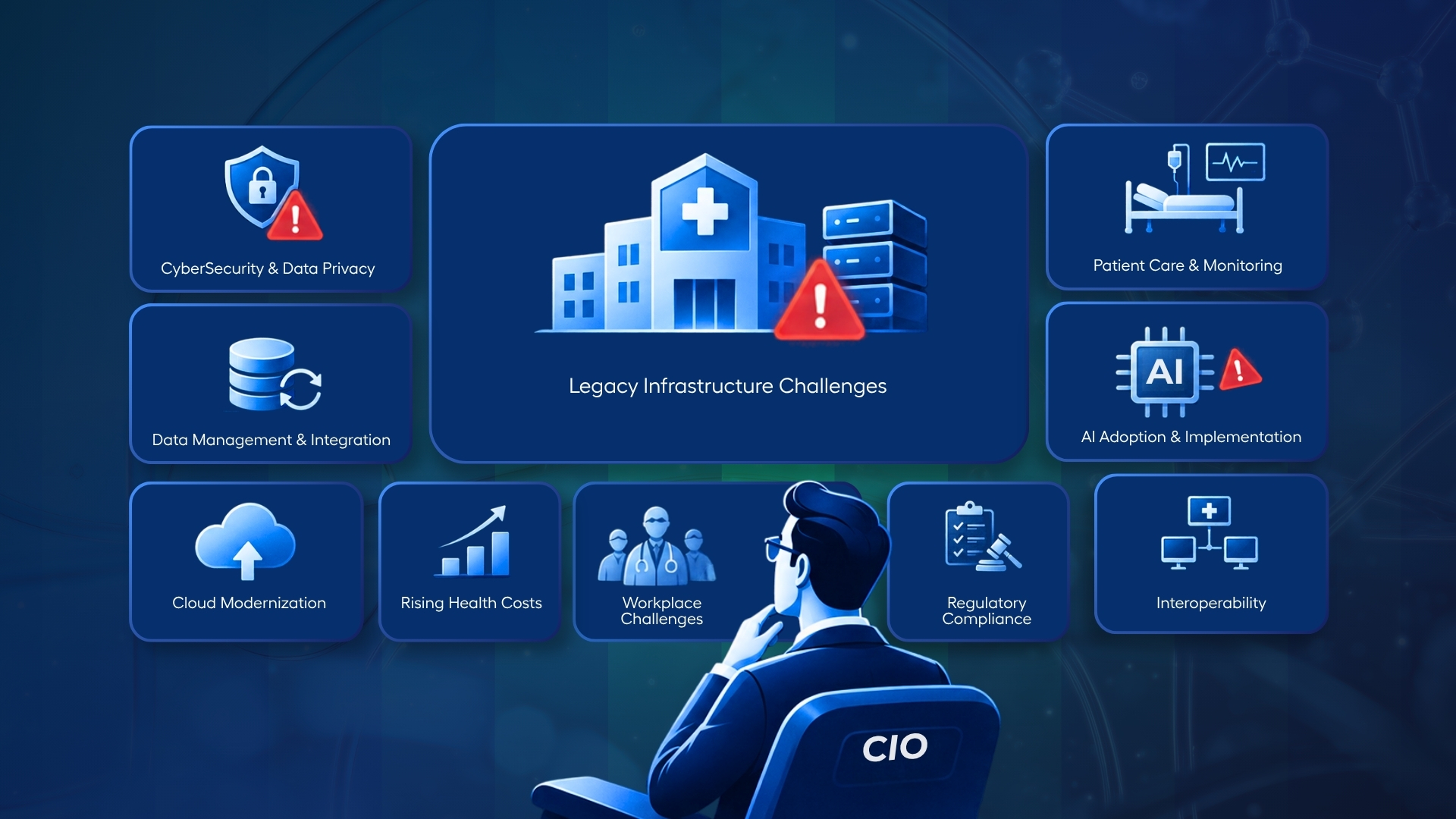
Healthcare leaders and particularly CIOs face challenges for healthcare modernization initiatives that can place their organization ahead of their competitor. Here are five pillar strategies that healthcare leaders can follow to stay at the top of their competition.
Pillar 1: Modernize the Data Foundation
Integrate:
- EHRs
- Claims systems
- Revenue cycle platforms
- Financial applications
- Population health systems
Without interoperable data, reporting automation is limited. Leading vendors have continuously identified data fragmentation as the largest barrier to analytics maturity.
Pillar 2: Automate Report Production
Automate:
- Data ingestion
- Data cleansing
- Quality validation
- KPI calculation
- Dashboard refresh
Healthcare automation programs have shown a reduction in repetitive reporting work and improved compliance.
Pillar 3: Eliminate Spreadsheet Dependency
Replace spreadsheet-based processes with governed analytics platforms.
Benefits:
- Improved data accuracy
- Accelerated refresh cycles
- Reduced audit risk
- Single source of truth
Healthcare reporting automation initiatives consistently flag spreadsheets as a key limitation.
Pillar 4: Deploy Executive Dashboards
Executives require:
- Real-time operational data
- Service-line KPIs
- Capacity and finance management KPIs
Organizations that have transitioned to continuous dashboard-based reporting dramatically decrease the time spent preparing recurring reports.
Pillar 5: Establish Analytics Governance
Includes:
- Data ownership
- KPI definition
- Access control
- Auditability
- Change management
Healthcare organizations with mature governance frameworks build greater trust and adoption of analytics.
Business Impact
For a mid-sized health system that creates hundreds of repeating reports each month:
| Metric | Before Modernization | After Modernization |
| Monthly reporting cycle | Days to weeks | Hours to days |
| Manual reporting effort | High | Reduced by 60-70% |
| Data reconciliation | Frequent | Automated |
| Compliance preparation | Manual | Automated workflows |
| Executive visibility | Retrospective | Near real-time |
There are documented case studies of health systems achieving a reduction in reporting effort by 60-70%, with some health systems achieving a greater reduction for a given workflow.
Conclusion
There is considerable evidence from healthcare systems, collaboratives, and healthcare modernization programs, showing that reporting time can be reduced by 60-70% through integration of clinical, financial and operational data, automation of workflows, data governance and self-service analytics.
The most successful health systems approached reporting modernization as a critical, high-value, and strategic program of work rather than a traditional business intelligence program. Connect with an expert from Sparity to learn more about modernizing your healthcare organization.
FAQs
What is healthcare modernization?
It is the renovation of data, analytics, and reporting systems to optimize productivity and efficiency, and facilitate better business decisions.
How can automating healthcare reporting help to eliminate reporting delays?
Automating data extractions and validations and automating KPI calculations and dashboard refreshes help eliminate labor-intensive, time-consuming activities thereby improving the speed of report deliveries.
What causes reporting delays in healthcare?
Data is located across several disparate systems including different EHRs, claims systems, finance systems, and spreadsheets, which take a lot of time and effort to consolidate and analyze.
What advantages does modernizing healthcare analytics provide?
It increases the accuracy of data, provides near real-time analytics, self-service reporting, and enables leaders to make rapid and informed business decisions.
How much time do healthcare organizations save with modernization?
Many healthcare organizations save 60-70% of the time previously spent on generating reports. Some workflows have achieved even greater improvements.
FAQs