
The Hidden Problem: AI Subscription Sprawl
AI ROI According to Gartner, spending on AI infrastructure will add $401 billion in spending in 2026 as technology providers build out AI foundations. This clearly justifies the 17% spending on AI-optimized servers for 2026.
Finance teams reviewing monthly SaaS expenses often find:
- Multiple AI subscriptions across teams
- Tools approved with excitement but rarely used
- Overlapping capabilities across platforms
What begins as experimentation quickly turns into:
- Duplicate tools
- Low adoption
- Untracked usage
- Rising operational costs
The above graph clearly depicts that among the AI tools, OpenAI leads enterprise AI adoption, far outpacing Anthropic and Google. Data from Ramp shows 46.6% of US businesses paid for AI services in December 2025.
AI Spending Is Exploding- Why AI Isn’t Paying Off Yet
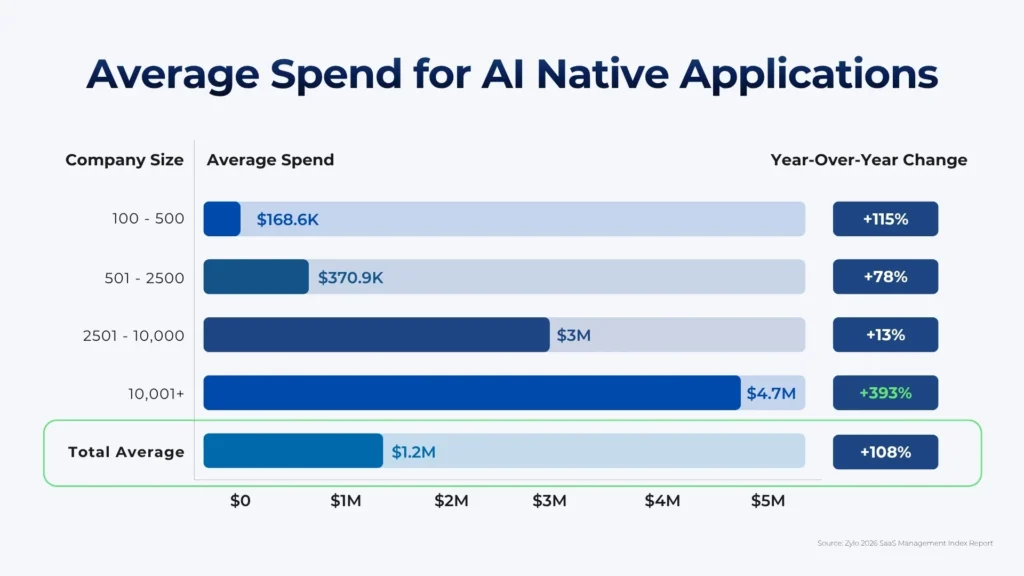
AI has become the fastest-growing line item in enterprise budgets but not the most efficient one. A study by Gartner has highlighted that worldwide cost of AI expense is forecasted to be $2.52 trillion by the end of 2026 which is a 44% increase from past year.
Also, the reports from Accenture, Deloitte, Google Cloud, McKinsey, Microsoft, and OpenAI all published serious research on enterprise AI adoption. Thousands of executives agreed that ROI gap is real, as most of the organizations are stuck in pilots.
The big question is how are other companies succeeding?
They are actually redesigning the work structure.
Investment has outpaced ROI maturity
Moreover, CEOs are balancing the pressure for short-term AI ROI with longer-term innovation goals. This results in AI initiatives that begin as experimentation and only later move toward value realization.
In the words of Dan Priest (Chief AI Officer at PwC), CFOs need to tighten the link between AI investments and business outcomes not just efficiency. The central aim of teams should be to back high-impact AI initiatives and ensure those efforts translate into measurable business value, not just incremental efficiency.
The priority should be to define clear value cases tied to growth, margin expansion, or better decision-making and to know when to stop scaling.
What Successful Companies Are Doing Differently
Organizations that are seeing real results are going beyond by:
- Embedding AI into core operations
- Aligning investments with business outcomes
- Scaling only what works
Where AI Actually Delivers Value
Not all AI use cases generate equal value. The difference lies in where and how AI is applied.
High-Impact, High-ROI Use Cases
AI delivers the most value when applied to core business workflows:
- Legal teams using AI to draft initial contracts, reducing manual effort
- Marketing teams leveraging AI ROI for rapid A/B testing and campaign optimization
- Finance teams automating reporting and forecasting processes
These use cases directly impact productivity, speed, and decision-making.
Low-Impact Use Cases
In contrast, AI investments often fail when:
- Tools are adopted for novelty rather than necessity
- Outputs are generated but not used in decision-making
- There is no clear ownership or workflow integration
The key differentiator is relevance to business outcomes.
As highlighted by PwC, leaders are now focusing on linking AI investments directly to measurable business value not just efficiency gains.
The Most Important Question Before Any AI Investment
Before adopting any AI tool, organizations should evaluate its direct impact:
- What specific workflow does this improve?
- What measurable outcome will it influence?
- Who will use it consistently, and how often?
- How will success be tracked and validated?
If these questions cannot be answered clearly, the likelihood of achieving ROI is significantly reduced.
Best Practices for Smarter AI Budgeting
To control AI costs and maximize AI ROI, organizations need structured financial discipline not ad-hoc spending. AI cost spent should be inclusive of value and keep on innovation governance while maintaining appropriate cost-to-value visibility. Without equilibrium, organizations risk building a financial black hole from their AI investments, or funding a governance snare with no room for innovation drain on progress. The balanced principles on which organizations should plan their artificial intelligence budget around include:
Strategic Alignment: Funding AI initiatives that directly support enterprise missions and connect to measurable business objectives.
Innovation Allocation: Ensuring an adequate financial reserve is isolated for experimentation efforts while maintaining a separation from scale production spend.
Governance-first Design: Building in compliance, security, and ethical controls
Cost Transparency: Supervision of AI cost across expenditure in the cloud, usage of AI budget tool, vendor, and operational teams.
Lifecycle Funding: Forecasting for ongoing AI spending for activities beyond initial deployment, such as monitoring, retraining, and maintenance.
Enterprises that adhere to the principles above create budgets that support innovation while maintaining an operational framework on governance. This makes sure that the ROI of investments in AI is both compliant and sustainable.
AI Audit Checklist: What to Do This Week
Here’s a practical AI Audit Checklist:
Step 1 — Map Everything You’re Paying For
Pull every AI subscription across every department. Zylo’s 2024 SaaS research found that businesses waste an average of 44% of their SaaS spend on unused or underutilized licenses AI tools follow the same pattern.
Step 2 — Check Real Adoption, Not Logins
Login data is misleading, hence measure active, meaningful usage. Flag any tool where fewer than 30% of licensed users engage with it weekly.
Step 3 — Run a 30-Day ROI Pilot Before Renewing
Before committing to annual billing, define one measurable outcome the tool should influence. Track it and if it doesn’t move, don’t renew.
Step 4 — Consolidate Overlapping Tools
IBM’s research confirms that only 16% of AI initiatives scale enterprise-wide often because organizations spread investment too thin across too many tools.
Step 5 — Schedule a Quarterly AI Spend Review
PwC recommends CFOs maintain ongoing discipline over AI portfolios continuously tying every active subscription back to a business outcome.
Maximize AI ROI While Controlling AI Costs
To maximize AI ROI, organizations must align investments with business outcomes and scale only high-impact use cases. AI ROI has the potential to transform how organizations operate but implementing it with clarity, discipline, and purpose is essential.
The companies that succeed will be the ones that invest with intent by focusing on high-impact use cases, measurable outcomes, and long-term value.
FAQs